


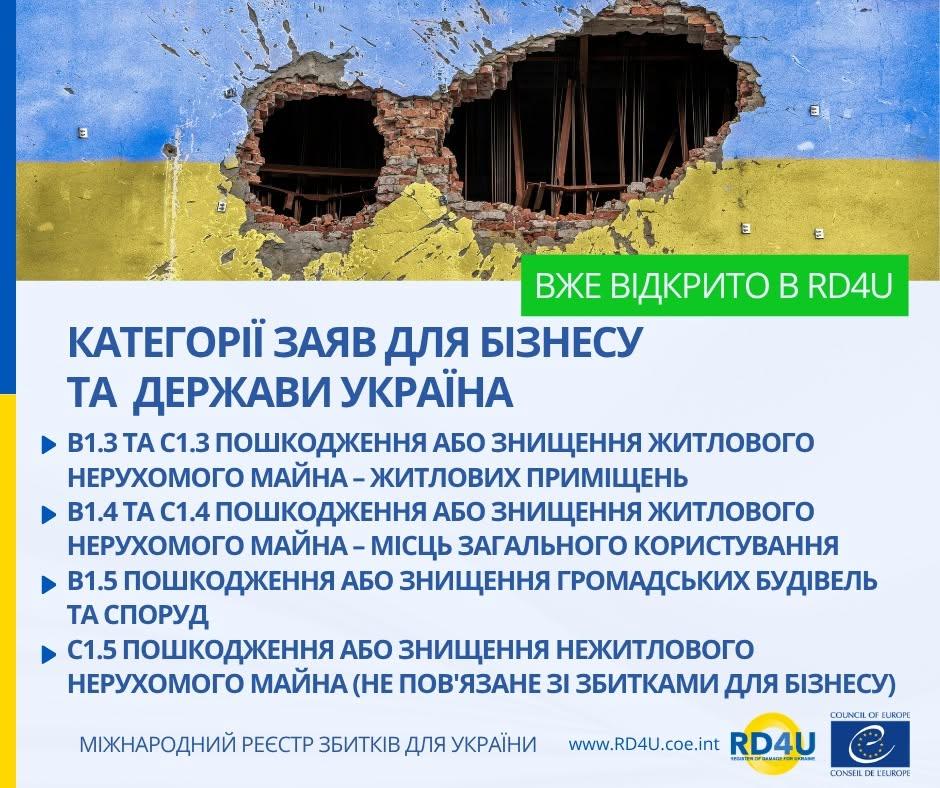
The International Register of Damages for Ukraine has opened the possibility of submitting claims for compensation for damages in new categories. The open categories concern damage to or destruction of immovable property owned by the State of Ukraine (category B) and legal entities (category C):
- B1.3 and C1.3 – Damage to or destruction of residential real estate – residential premises
- B1.4 and C1.4 – Damage or destruction of residential real estate – common areas
- B1.5 – Damage or destruction of public buildings and structures
- C1.5 – Damage to or destruction of non-residential real property (not related to business losses).
Series B categories (State of Ukraine) : applications may be submitted by the State of Ukraine, including its central, regional and local authorities (local self-government bodies), as well as state and municipal institutions and organizations.
Series C categories (Legal entities) : available to legal entities established under the laws of Ukraine or another state (except the Russian Federation), regardless of the form of ownership or organizational and legal form, including associations of co-owners of apartment buildings (OSBB), housing and construction cooperatives (ZHBK), public associations, charitable and religious organizations.
What damages can be claimed?
Applications in these categories may be submitted for compensation for damaged or destroyed real estate, namely:
- Residential premises (B1.3 and C1.3) : These categories are analogous to the previously open category for individuals (A3.1). They cover the destruction or damage of individual residential premises (apartments, private houses, official and departmental housing) that are state, municipal or legal entity owned. Claims can be submitted for the value of the destroyed property or the costs of its repair or restoration.
- Common areas in residential buildings (B1.4 and C1.4) : These categories supplement the compensation for damages for residential premises. They cover the destruction or damage of common areas and structural elements of multi-apartment residential buildings and dormitories: stairwells, entrances, corridors, elevators, basements, technical rooms, facades, roofs and engineering communications. These objects constitute a significant part of the material value of the building, and the costs of their restoration, current or major repairs are subject to proper documentation and compensation.
- Public buildings and structures (B1.5) : The category covers buildings and structures for public purposes that are state or municipally owned and are not classified as infrastructure (e.g. administrative buildings, cultural and sports facilities, etc.). The application can be submitted for the value of the destroyed building/structure or the costs of its repair or reconstruction.
- Non-residential real estate of legal entities not related to the conduct of business (C1.5) : This category is intended for legal entities whose non-residential real estate was damaged or destroyed, if such property was not used directly for the conduct of commercial activities for the purpose of generating profit. In particular, this applies to non-residential buildings, premises and structures used for public, charitable, humanitarian, religious or social activities. Claims for commercial real estate and other direct business losses will be submitted within the scope of category C3.1, which is already open.
The opening of these categories creates an opportunity to systematically document such losses and form a complete international evidence base on which decisions on compensation will be made.
How to apply
Applications are submitted through the web portal Diia . On behalf of a legal entity or state authority, this can be done by the head of the legal entity (for example, a director or chairman), whose information is entered in the Unified State Register, using his own qualified electronic signature (QES).
The manager also has the opportunity to delegate the right to submit applications to an authorized representative by creating a digital authority (electronic power of attorney) on the Diia portal.
B1.3 and C1.3 – Damage to or destruction of residential real estate – residential premises
B1.4 and C1.4 – Damage or destruction of residential real estate – common areas
B1.5 – Damage or destruction of public buildings and structures
C1.5 – Damage to or destruction of non-residential real property (not related to business losses)
You can learn more and apply on the Registry website .