


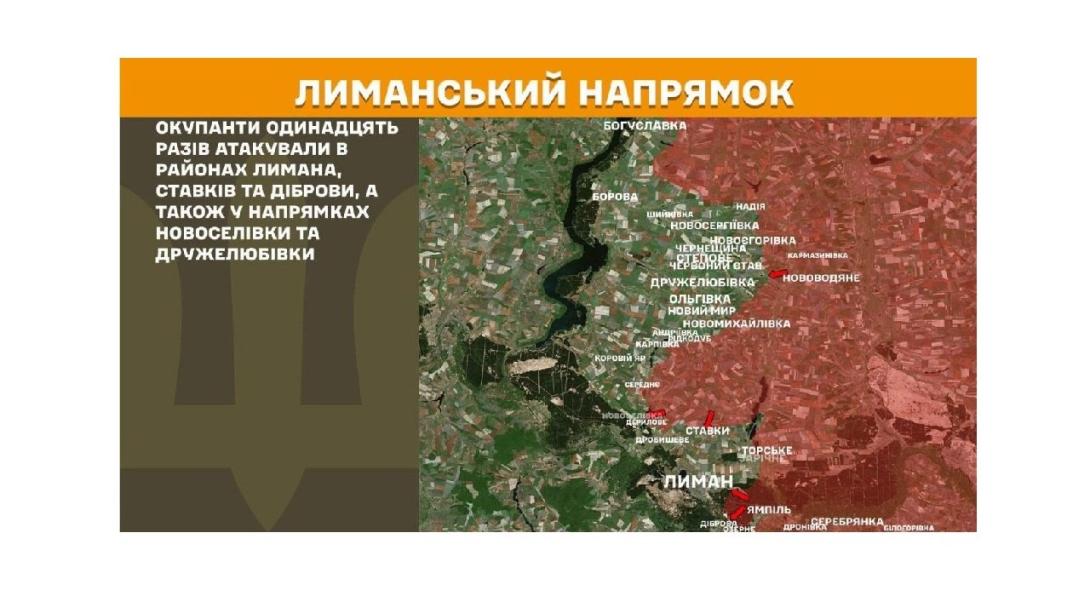
"Russian troops attacked the region 14 times. The enemy acted mainly from the air, carrying out 12 strikes using FPV drones and dropping explosives from drones, and also used automatic grenade launchers twice. In the Lyman direction, the armed forces were able to repel eleven attempts to break through our defenses, in particular in the direction of the village of Druzhelyubivka on the border of Kharkiv and Luhansk regions," said Oleksiy Kharchenko, head of the regional government.
In the temporarily occupied territories of Luhansk region, the situation with critical infrastructure is rapidly deteriorating due to large-scale power outages. Power outages have currently been recorded in the Svatyiv, Starobilsk, Kreminsk districts and on the outskirts of Lysychansk. Local residents note that regular power outages are directly related to the inability of the Russian occupation administrations to maintain the operation of the captured power system, as well as to critical wear and tear of equipment due to the lack of proper maintenance. At the same time, unstable voltage in power grids leads to a domino effect: in many settlements, concomitant problems with water supply and communication have already arisen.
In addition, the region is experiencing a sharp increase in prices and a real shortage of fuel for the population. Despite the occupation administrations' statements about the supposedly controlled situation and calls to refrain from excessive purchases, the real situation remains critical: A-92 and A-95 gasoline is currently being sold exclusively to legal entities for cashless payments. For ordinary drivers, strict restrictions continue to apply in the form of a limit of up to 20 liters per car tank, while the sale of fuel in canisters is strictly prohibited, which completely paralyzes the operation of household generators and agricultural machinery. Local residents complain about a two- or even three-fold increase in the cost of fuel and predict that such a situation will inevitably provoke a sharp increase in the price of food and other essential goods in the near future.