
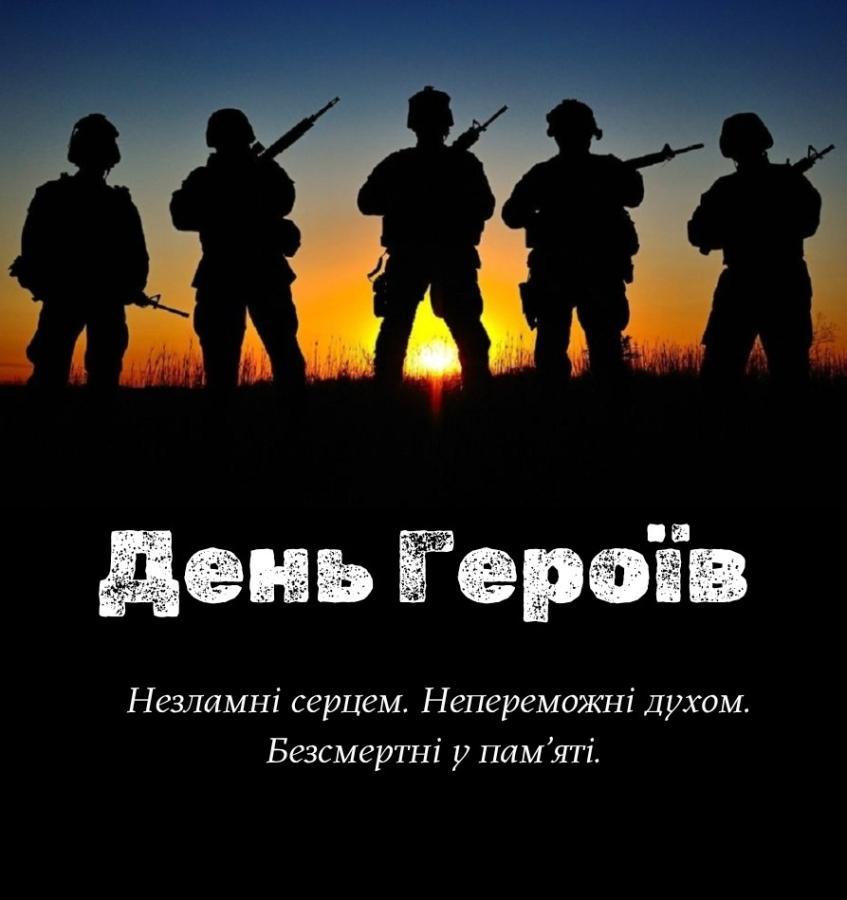
Heroes of Ukraine Day is not just a historical date, but first and foremost a day of deep national remembrance, dedicated to all who gave their lives for the freedom of Ukraine. On this day, we remember the courage, bravery, and indomitable spirit of the Ukrainian people.
The idea of the Heroes' Day originated among Ukrainian nationalists. The holiday was first officially introduced in April 1941 by a resolution of the Second Great Assembly of the Organization of Ukrainian Nationalists in Krakow.
It was celebrated underground during World War II and later in the Ukrainian diaspora.
During the Soviet period, the celebration was banned in Ukraine, but after the restoration of independence in 1991, the tradition gradually returned.
For many decades, Ukrainians have honored the memory of the Heroes who laid down their lives in the struggle for the freedom and independence of Ukraine.
This holiday emphasizes the continuity of the struggle for independence and reminds us of the price of freedom. Its meaning focuses not only on the events of the past, but on the continuous connection of generations who fought and continue to fight for independence.
This date is associated with the figures of Mykola Mikhnovsky, Symon Petliura, and Yevhen Konovalets.
Mykola Mikhnovsky
Born on March 31, 1873 in the Poltava region into the family of a village priest, he was a public and political figure, publicist, and one of the ideologists of Ukrainian nationalism.
In 1899, he moved to Kharkiv, where he practiced law and quickly integrated with the local Ukrainian community.
While studying at the Law Faculty of St. Volodymyr's University of Kyiv, Mikhnovsky joined the secret political organization "Brotherhood of Tarasovites", founded in 1891 on Tarasova Gora in the city of Kaniv.
Author of the program document of the Tarasov Brotherhood “Credo of the Young Ukrainian”, which defines the goal of creating a new national ideology and restoring the independence of the Ukrainian Soborna State.
In late 1901 and early 1902, he became a co-founder and one of the leaders of the Ukrainian People's Party (UNP), which aimed to fight for the independence of Ukraine. He wrote the "Ten Commandments of the UNP" and the party program, in which he outlined the basic ideology of Ukrainian nationalism: "One, united, indivisible from the Carpathians to the Caucasus, independent, free, democratic Ukraine - the Republic of working people - this is the national all-Ukrainian ideal. Let every Ukrainian child understand that he was born into the world to realize this ideal."
He tried his best to convey his ideas to people: he founded a Ukrainian-language magazine, published his articles in the press, published books, and defended Ukrainian activists in court.
With the outbreak of World War I in 1914, he was mobilized into the Russian army and served as a lieutenant in the Kyiv District Military Court.
One of the first to advocate the idea of forming its own armed forces. In early 1917, he founded and headed the Ukrainian Military Club named after Pavlo Polubotko. The military council of the Kyiv garrison, after Mikhnovsky's report, 2 elected the Ukrainian Military Organizational Committee and decided to immediately begin organizing its own national army. The committee declared its task to be the Ukrainization of the Russian army, that is, the formation of Ukrainian units in its composition; the creation of Ukrainian public organizations in army units; the immediate organization of the first Ukrainian regiment. Mykola Mikhnovsky said this in his emotional speech during the Ukrainian demonstration on March 19, 1917 in Kyiv.
In March 1917, three military veches were held, during the last of which a decision was made to form the first Ukrainian volunteer regiment named after Hetman B. Khmelnytsky. He did not share the socialist views of the leadership of the Ukrainian Central Rada, which tried to limit the activities and influence of the independentists led by Mikhnovsky in the army.
On March 15, 1917, he gathered his like-minded people and proclaimed the creation of an alternative to the Ukrainian Central Rada, which clearly declared its independent nature.
After the establishment of Bolshevik power, he lived in the Kuban for some time, and in 1924 he returned to Kyiv, where he was immediately arrested by the GPU.
His disappointment knew no bounds. “Numerous elements hostile to Ukrainianism and their own inhabitants, the Little Russians, skeptically indifferent to the national aspirations of the Ukrainian people, created that clay-swampy background on which they found no ground for the manifestation of strong national energy,” – this is how his colleague at the pedagogical college, Mykola Marchenko, described the Kyiv months of Mykola Mikhnovsky’s life.
On May 3, 1924, Mykola Mikhnovsky was found hanged in the garden of his friend Volodymyr Shemet’s estate. His suicide note read: “I prefer myself to them”…
Symon Petliura
He was born on May 22, 1879, in a suburb of Poltava, into a family of burghers of Cossack origin.
He received his primary education in a church-parish school. In 1895, he entered the Poltava Theological Seminary, where he was fond of history, singing, playing the violin, and literature.
In 1901, he participated in the All-Ukrainian Student Congress, representing the community of the theological seminary.
Fleeing arrest, Symon Petlyura left for the Kuban with his friend Prokop Poniatenko in 1902. He taught in Ekaterinodar (now Krasnodar). However, he was soon arrested for his activities in the Black Sea Free Community (Kuban organization of the RUP) and the distribution of anti-government proclamations. He was later released but was banned from teaching as “unreliable.” So the Kuban historian, corresponding member of the Russian Academy of Sciences, Fedor Shcherbina, proposed to organize the archives of the Kuban Cossack army. There, Petlyura established himself as a qualified worker. At that time, he prepared his first scientific article “On the Language of the Public Schools of the Kuban Region.”
In Kuban, Petliura began writing articles for newspapers. In 1902, he established cooperation with the “Literary and Scientific Bulletin”, and the following year, with the “Notes of the Shevchenko Scientific Society”. He also wrote for the RUP newspapers “Dobra Novina”, “Pratsia”, and the monthly “Haslo”. At the request of the Revolutionary Ukrainian Party 3, he set up a mini-printing house in his own apartment to produce anti-tsarist leaflets. In December 1903, he was arrested for revolutionary activities.
In March 1904, he was released on bail and returned to Kyiv.
During the 1905 revolution, he took an active part in the activities of the Ukrainian Social Democratic Party, which separated from the Revolutionary Ukrainian Party.
During the Ukrainian Revolution of 1917-1921, he was the chairman of the Ukrainian General Military Committee, the General Secretary of Military Affairs, the creator of the Haydamak Basket of Slobodsk Ukraine, the Chairman of the Directory of the Ukrainian People's Republic, and the Chief Ataman of the Army and Navy of the UNR.
After the revolution, in emigration to Poland, he headed the State Center of the Ukrainian People's Republic in exile: he opposed the Bolsheviks in the international arena, tried to preserve Ukrainian state institutions and the army, unite the Ukrainian emigration around the continuation of the struggle, and enlist the support of Western governments.
Assassinated on May 25, 1926 by Soviet agent Samuel Schwarzbard in Paris. Despite a large-scale campaign to discredit Symon Petliura, his name remained a symbol of indomitability and the struggle for Ukraine's independence for many Ukrainians.
Yevhen Konovalets
Born on June 14, 1891, into a teacher's family in the village of Zashkiv, near Lviv.
After studying at a folk school and gymnasium, which he graduated from in 1909, he studied at Lviv University at the Faculty of Law, preparing for legal work. At the same time, he also took a full course in the history of Eastern Europe and Ukraine under the guidance of Professor Mykhailo Hrushevsky. As a student, he was active in public and political activities. Since 1912, he was the secretary of the Lviv branch of “Prosvita”, actively collaborated with the organization’s printed organ – the monthly “Letter from Prosvita”, and became a member of the “Academic Community”.
In 1913, as one of the leaders of the Ukrainian student movement, he was elected to the main board of the Ukrainian Student Union, where he belonged to the national-democratic section. Soon he became a member of the Ukrainian National-Democratic Party.
In 1914, Yevhen Konovalets was mobilized into the Austrian army, and the following year, after the battle at Makiivka, he was taken prisoner by the Russians.
In October-November 1917, he became one of the initiators of the creation of the Galicia-Bukovina kuren of the Sich Riflemen, the basis of which was mainly Ukrainians, former soldiers of the Austro-Hungarian army who were captured by the Russians during the First World War. The first commander of the kuren was Vasyl Didushok, and from January 1918 - Yevhen Konovalets. Under his leadership, the Sich Riflemen became one of the most combat-ready units of the Army of the Ukrainian People's Republic. In late January - early February 1918, the Sich Riflemen played a notable role in suppressing the Bolshevik uprising in Kyiv at the Arsenal factory and in battles with units of Muravyov's army. After Hetman Skoropadsky came to power, the Sich Riflemen regiment was disarmed and disbanded in May 1918 at the request of the German command. However, in August of the same year, Skoropadsky 4 gave permission to form a Separate Detachment of Sich Riflemen in Bila Tserkva, also headed by Yevhen Konovalets.
After Skoropadsky proclaimed the Federal Charter with Russia, the Sich Riflemen supported the anti-Hetman uprising and took an active part in the battles against the Hetman units formed from the Russian “White Guards”. During the siege of Kyiv in November-December 1918, Yevhen Konovalets commanded the Siege Corps of the Directory troops.
During 1918–1919, he was one of the most influential military and political leaders of the Ukrainian People's Republic. At the same time, he refused to become the sixth member of the Directory of the Ukrainian People's Republic, and later its dictator.
After the defeat of the Ukrainian Revolution of 1917-1921, Konovalets did not lose faith in the cause to which he had devoted his entire life. He was a very talented diplomat. All the time from the founding of the Ukrainian Military Organization until his death abroad, Konovalets tried to establish relations with foreign organizations, in particular with the League of Nations, the Japanese and the Germans. He carried out a number of measures, as a result of which the cells of the Organization of Ukrainian Nationalists or related organizations were created in France, Belgium, and Manchuria. With his direct participation, the Ukrainian Riflemen's Communities were founded in America, which laid the foundation for the Organization of the State Revival of Ukraine in the USA and the Ukrainian National Union in Canada. In order to prepare for the future armed struggle for the independence of Ukraine, on Konovalets' instructions, a military headquarters was formed and schools for the training of non-commissioned officers for the Ukrainian army were staffed in Poland, Czechoslovakia, and Austria.
Konovalets survived several assassination attempts. In 1933, planning began in Moscow to assassinate Yevgeny Konovalets: this Chekist operation was codenamed “Stavka”. The Soviet Foreign Intelligence Service agent Pavlo Sudoplatov, who, according to legend, was a representative of the Ukrainian underground in the Ukrainian SSR, managed to gain the trust of the OUN Leader. On May 23, 1938, he handed over a box of chocolates with an explosive device embedded in it. Yevgeny Konovalets is buried in Rotterdam at the Crosswijk cemetery.