
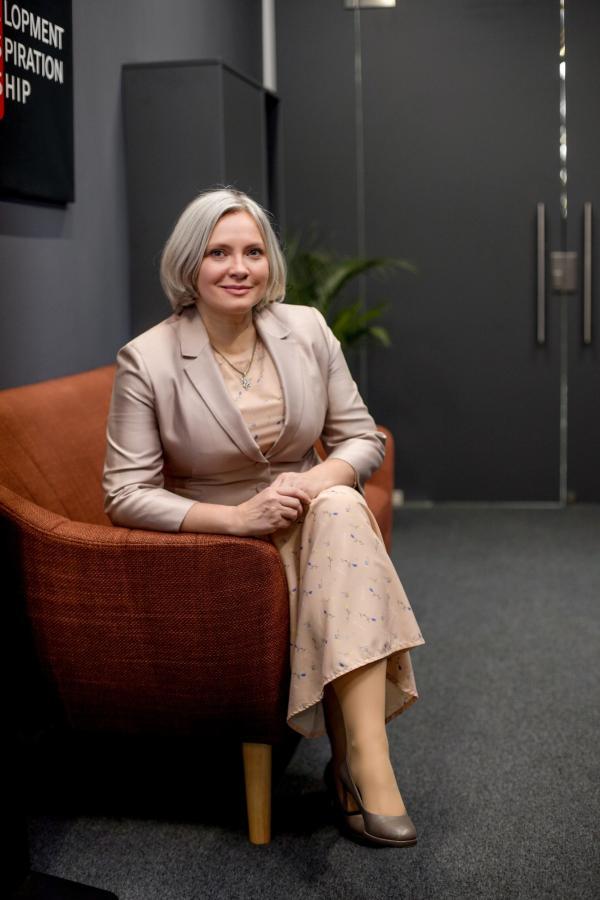
Olena Nizhelska is the coordinator of four projects on the implementation of the Regional Action Plan 1325 and an expert on the implementation of the Agenda “Women. Peace. Security” at the regional level. In 2025, she participated in the development and implementation of the regional communication campaign 1325, and also carried out expert monitoring of the implementation of the Regional Plan 1325 with the preparation of recommendations for authorities. She is a trainer of the SHE LEADS UKRAINE program and heads civil society organizations, combining media, advocacy and analytical activities to strengthen the participation of women in security and recovery processes. She initiated the “Budgets in Exile” approach to maintain accountability and participation of communities in conditions of displacement. Her activities are aimed at integrating the principles of the Regional Plan 1325 into regional policy, humanitarian response and decision-making processes. In the interview, Ms. Olena spoke about her achievements, the importance of human stories, and shared her vision for increasing women's involvement in decision-making.
Over the past year, the public organizations represented by Ms. Nizhelska have implemented a number of projects, including those directly related to UN Resolution 1325. One of them, says Ms. Olena, was of a research nature, and the second was more applied. The first project was called "Luhansk Region 1325. We educate, monitor, inform." It was aimed at improving the implementation of the Regional Action Plan in the Luhansk region, because despite the fact that the territory of the region is almost completely temporarily occupied, people who associate themselves with the communities of Luhansk region strive to remain in the informational, cultural and social field of ties with their region of origin:
— The name of the project — “We Teach, Monitor, Inform” — reflects three basic components. The first component is educational. A number of educational and training events were held within its framework. The main topics were respect for human rights, international humanitarian law, and raising awareness of the rights of women and children in armed conflicts. The formats were different: full-fledged trainings, webinars, workshops that combined the theoretical part and practical skills for participants, — shares Ms. Olena, — The second component is monitoring. It was aimed at assessing the implementation of regulatory documents on the functioning of specialized support services for persons affected by violence. The third component is informational. The organization that implemented the project — the crisis media center “Siverskyi Donets” — could not leave it without an information campaign. We created and distributed modern information materials: long-reads, caption videos, thematic cards. This made it possible to talk about Resolution 1325 and related topics to a much wider audience.
The combination of educational, monitoring, and informational approaches, the coalition member emphasizes, contributed to the success of the project: when the implementation of the 1325 Regional Plan for 2025 was monitored, it was noted that the contribution of civil society institutions, including our organization, was significant.
The second project was applied, says Ms. Nizhelska. Its name is “Kreminna nearby. A safe space for women and children in Dnipro”. It was aimed at creating a safe, comfortable and caring environment for women, children and internally displaced persons currently in Dnipro. The partners were the Kreminna City Military Administration and their communal institution “Dobro”.
— I really like projects that combine the so-called hard and soft components, — says the interlocutor, — The hard component involved partial renovation of the premises, updating the equipment — in particular laptops, and creating the ability to maintain a comfortable temperature in the premises. This winter, this was critically important. Charging stations were also purchased, which allowed us to continue working and providing services during power outages. In addition, information boards were installed, which became a platform for informing visitors to the hub about opportunities in the community and available services for IDPs.
The soft component, the speaker says, is educational. A speech therapist worked with the children of internally displaced persons, simultaneously providing practical advice to parents on responding to the challenges of war. Communication trainings were held - how to communicate, how to talk about difficult topics:
— We took special care of the hub workers. Most of them are women who are IDPs themselves. For them, it’s a double burden. The burnout training was very useful, because every day they work with people in difficult circumstances and have to remain resilient. These two projects were implemented in 2025. This may be a small but important contribution to the implementation of the 1325 Regional Plan.
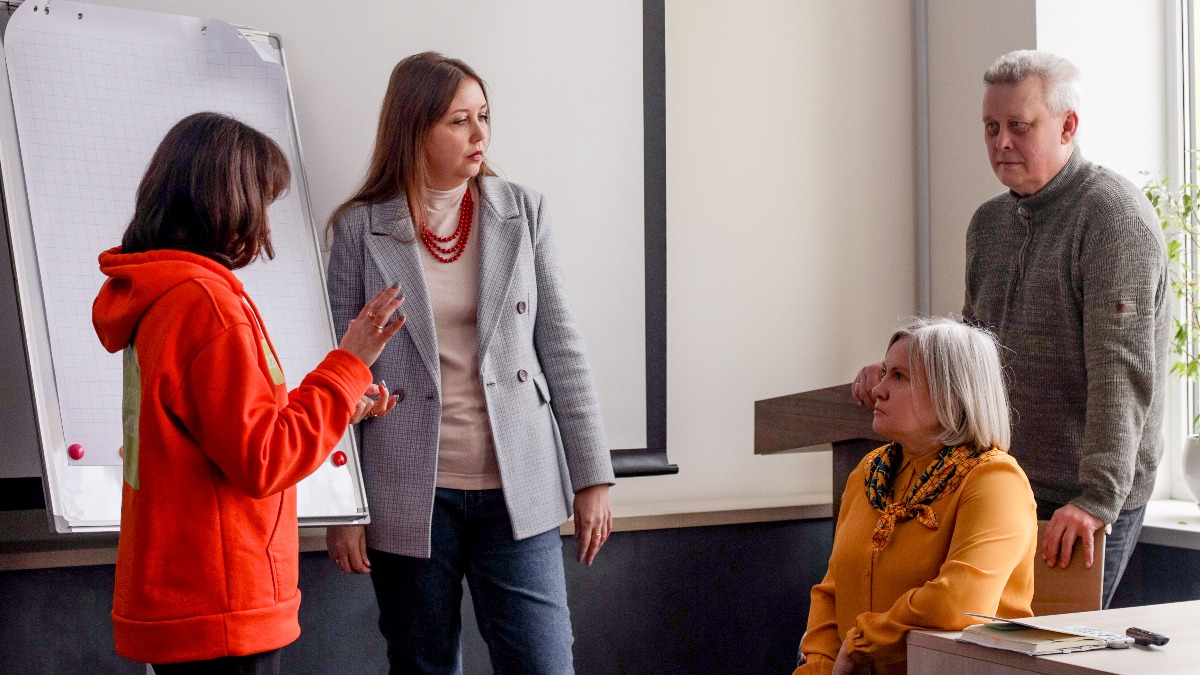
Ms. Nizhelska emphasizes that it is important to talk about UN Resolution 1325 itself not only in the language of documents, but also through people's stories. After all, simple language is an element of accessibility.
— Now, simple language is an element of accessibility. What I don’t like most about the National and Regional Plans 1325 is the complex language in which they are written. A person doesn’t see themselves there. If they are not an expert in gender equality issues, it is almost impossible to understand these complex formulations. And when we speak in the language of living stories — how a specific woman influenced decision-making and solved a problem in her community — it is perceived differently. A success story is the most powerful tool. When someone succeeds, others think: “I can do it too.”
Therefore, the woman emphasizes, when preparing the new Regional Plan, she strongly recommends that it be presented in simpler language for women and men, boys and girls, who must understand what it is about and where their place is in this plan.
"I want women to be not only the "rear" who prepares decisions, but to directly influence their adoption and implementation"
During the monitoring of the implementation of the Regional Plan1325, it was found that there are more women than men in collegial bodies, headquarters, and working groups. But if you look at who heads them, says Ms. Olena, men predominate at the decision-making level.
— I want women to be not only the “rear” who prepares decisions, but to directly influence their adoption and implementation. At the national level, I want to see women at the negotiating table. Studies show that when women are present in negotiating groups, peace comes faster and is more sustainable. For me personally, the marker is to see women in the negotiation process.
Discussing the topic of local self-government, Ms. Olena emphasizes: society today faces a huge task to at least preserve it.
— In Luhansk region, local self-government bodies have been temporarily replaced by military administrations. This is a different model of governance — not collegial, but more one-person. And that is why we need to actively use the tools of local democracy right now — information requests, citizens' appeals, public discussions, consultations. Even remotely. Because consultations and dialogues are a difficult path, but without them there is no democracy. Our task is to remain in the information field and remind: decision-making depends on each and every one.
The material was created in cooperation with the Ukrainian Women's Fund with the support of the governments of Great Britain, the Netherlands and Canada and with the assistance of the Government Commissioner for Gender Policy