
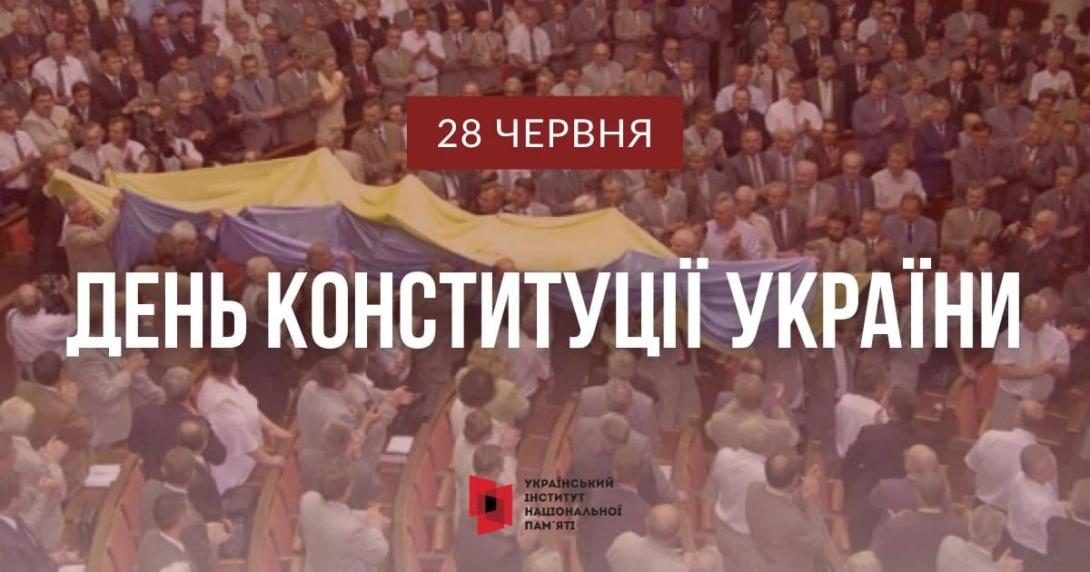
On June 28 of this year, Ukraine celebrates the 30th anniversary of the Constitution, the main regulatory legal act of our state, which establishes the foundations of the social order, state structure, system, procedure for formation, principles of organization and activity of state and self-government bodies, and the rights and obligations of citizens.
The adoption of the Fundamental Law by the Verkhovna Rada of Ukraine in 1996 was an important milestone in Ukrainian statehood.
Ukrainian constitutionalism has deep historical roots and continuity, as well as its own characteristics. The most important is the assimilation of European traditions and ideas of human rights and freedoms, the rule of law and democracy. These principles have been formed over the centuries and adapted to the national character of Ukrainians, the way of life, values and social relations of our ancestors.
The first known codification of law on Ukrainian lands occurred during the medieval Ukrainian state of Rus and was recorded in the “Ruska Pravda” (11th–12th centuries). Subsequent historical eras demonstrated a continuous search for ways, methods, and tools to formalize and consolidate the main principles of social and state interaction.
Sometimes Ukrainian constitutionalism even outstripped European constitutionalism. Thus, the first European constitution in its modern sense is rightly considered to be the “Treaty and Establishment of the Rights and Freedoms of the Zaporozhian Army and the Entire Free People of Little Russia between His Serene Highness Hetman Pylyp Orlyk and the General Staff, Colonels, and the aforementioned Zaporozhian Army, which, according to ancient custom and military rules, were approved by both parties by free vote and confirmed by the most distinguished Hetman with a solemn oath.” This treaty of 1710, written under the significant influence of the ideas of Western European parliamentarism, is called the Pylyp Orlyk Constitution.
The founding acts of the Ukrainian People's Republic, the Ukrainian State of Hetman Pavlo Skoropadsky, and the Western Ukrainian People's Republic demonstrated the legal and political maturity of our nation during the struggle for statehood in 1917–1921. The traditions were continued on March 15, 1939, by the Soyum of Carpathian Ukraine in Khust, proclaiming its independence and adopting two laws with constitutional status that determined the form of state government.
The program documents of the Ukrainian Main Liberation Council as an underground parliament testified to the desire of the participants in the liberation movement to adhere to the principles of democracy even in the most difficult conditions of the underground partisan struggle.
The constitutional process of independent Ukraine reflected the difficult path of the young democracy to the social and legal standards and values of a united Europe.
Historical background
The Constitution of Ukraine has a history of over a thousand years. Its origins are “Ruska Pravda”, “Lithuanian Statutes”, acts and universals of the Hetmanate period – legal acts of a constitutional nature that put Ukraine on a par with other European countries.
During the Ukrainian Revolution and liberation struggles of 1917–1921, the constitutional process began immediately after the proclamation of the First Universal of the Central Rada. On April 29, 1918, the Small Rada approved the “Statute on the State Structure, Rights and Freedoms of the UNR,” which proclaimed the UNR a sovereign state, “independent and independent of no one.”
The state-building processes of this period were halted by the long-term occupation of Ukrainian lands by the Russian army. The Soviet Union, where authoritarianism and totalitarianism had reached their extreme stage, produced in a few decades a number of basic laws that would have been enough for civilized countries for a millennium. However, all of them only declared a certain set of democratic values, behind the scenes of which a new empire was emerging.
The first Constitution of the Russian-occupied Ukraine (USSR) was adopted in March 1919. The “bright future” was to be guaranteed by the dictatorship of the proletariat and full solidarity with other Soviet republics for the sake of “a joint struggle for the triumph of the world communist revolution.” After the formation of the USSR in 1922, the All-Union Constitution was approved on January 31, 1924. At the 11th All-Ukrainian Congress of Soviets in 1929, a new Constitution of the USSR was drawn up, which legally secured Ukraine’s entry into the USSR and subordinated republican legislation to all-Union standards.
After Ukrainians “experienced” the triumph of Soviet “democracy” in practice through collectivization, dispossession, and the Holodomor genocide, a new, so-called “Stalinist” Constitution of the USSR appeared in 1936. It legally secured the “victory” of socialism. The document had a number of democratic innovations (purely declarative): universal, equal, and direct suffrage; secret ballot; the right to work and rest, and material security in old age. The next Constitution of the Ukrainian SSR of 1937 repeated the provisions of the union document, limiting the powers of republican bodies as much as possible.
After the debunking of Stalin's personality cult, "new horizons" of an ideal society opened up. Party leaders saw other democratic standards. So, first in the USSR (in October 1977), and then in Ukraine, they invented a recipe for a social ideal, enshrined in the Constitution of the Ukrainian SSR of April 20, 1978. This also refers to a sovereign republic. And "all power in Ukraine belongs to the people."
The collapse of the Soviet empire also became the collapse of the basic law, which, despite all the lofty epithets, legitimized totalitarianism and was unsuitable for building a legal, democratic society.
The latest constitutional process is inextricably linked to the restoration of Ukrainian statehood. The creation of the Constitution began with the adoption of the Declaration on the State Sovereignty of Ukraine on July 16, 1990. The processes of national lawmaking intensified with the collapse of the USSR and the adoption of the Act of Proclamation of Independence of Ukraine on August 24, 1991. An all-Ukrainian referendum confirmed support for the declaration of independence of Ukraine. Most countries of the world recognized Ukraine as a sovereign state. Therefore, the issue of preparing the Basic Law became urgent.
5 facts about the preparation and adoption of the Constitution
The draft Constitution of Ukraine was prepared by the Constitutional Commission. In 1992, it was subject to a national discussion, and on October 26, 1993, the final version was prepared. Then the matter was suspended for almost a year. In November 1994, after early presidential and parliamentary elections, the new people's representatives created another Constitutional Commission.
Another milestone on this path was the signing of the Constitutional Agreement between the President of Ukraine and the Verkhovna Rada of Ukraine on the organization of state power and local self-government for the period of preparation of the new Constitution of Ukraine (June 8, 1995).
On the eve of its adoption, in June 1996, the situation escalated. On June 26, the National Security Council and the Council of Regions under the President of Ukraine sharply condemned the delay in adopting the Fundamental Law. The President scheduled a referendum on its adoption for September 25. And the next day, the Verkhovna Rada of Ukraine voted for the Resolution “On the Procedure for Considering the Draft Constitution of Ukraine in the Second Reading”. And a real marathon began, lasting almost 24 hours. Of these, the last 14 hours were without a break.
Among the issues that were most hotly debated were state symbols (the left categorically did not agree to the trident and the blue-yellow flag), language, and the status of Crimea (some right-wing deputies insisted on granting the peninsula the status of a regular region). After repeated votes, a compromise was finally reached. The language issue was also not easily resolved: Ukrainian became the sole state language, while the Constitution guaranteed the free development and use of Russian and other languages of national minorities.
At 09:20 on June 28, 1996, the first Constitution of independent Ukraine was voted on. It enshrined the legal foundations of the state, its sovereignty and territorial integrity, the fundamental rights and freedoms of Ukrainian citizens. A person, his life and health, honor and dignity, inviolability, and security are recognized as the highest social value. The Constitution of Ukraine contains norms of direct action. One of the key provisions was Article 5, according to which “the bearer of sovereignty and the sole source of power in Ukraine is the people.”
However, the constitutional process did not end there. Constitutional construction continues as long as the state exists and society develops.
Milestones in the development of Ukrainian constitutional thought
Medieval prehistory of Ukrainian constitutionalism – from “Russka Pravda” to the Lithuanian Statutes. “Russka Pravda” began to be compiled in the 11th century during the reign of Yaroslav the Wise. This is the first known codification of law in Ukrainian territories, which imitated the legislative acts of the Germanic and Anglo-Saxon states of Europe. Emphasis on the rights of various estates, property, and judicial proceedings. The Lithuanian Statutes codified the law of the Grand Duchy of Lithuania. Three editions of the statutes (1529, 1566, 1588) written in the clerical Rus’ (Ukrainian) language incorporated the legal traditions of Rus’ and medieval Europe. They established the boundaries of princely power and protected the rights of various social classes.
The emergence of domestic constitutional thought is associated with the liberation revolution led by Hetman Bohdan Khmelnytsky and the revival of the Cossack state (2nd half of the 17th - end of the 18th century). The internal structure, socio-economic development, rights and freedoms of the Cossacks were determined by Hetman universals, in particular Bohdan Khmelnytsky, as well as international treaties (for example, the Zboriv between the Cossacks and the Polish King Jan Casimir). Bohdan Khmelnytsky's March Articles regulated the political, legal, financial and military situation of Ukraine after the Pereyaslav Council. The Hadyatsky Treatise provided for the creation of the Grand Duchy of Rus' within the Commonwealth. A significant milestone in the development of constitutional thought in Ukraine at that time was the Constitution of Hetman Pylyp Orlyk in 1710.
An important step towards codifying the legal norms that operated on the territory of the Ukrainian Cossack state was the creation in 1743 of a draft document “The Laws by which the Little Russian People are judged”. This was a code of Ukrainian legislative and regulatory acts of the 18th century. “The Laws…” were distributed in handwritten lists, applied in legal proceedings, and used as a textbook. In the legal sense, “The Laws…” were not an official source of law. However, an analysis of the judicial practice of the 18th century. testifies to their practical application by the judicial institutions of the Hetmanate.
Formation of constitutional ideas after the loss of statehood (late 18th - early 20th centuries). Mykola Kostomarov developed his own constitutional projects in the “Book of the Life of the Ukrainian People”, Mykhailo Drahomanov in the work “Free Union”, and a member of the Cyril and Methodius Brotherhood, Georgy Andruzky, in “Sketches of the Constitution of the Republic”. In general, the Cyril and Methodius Brotherhood, in the conditions of increasing reaction during the time of Emperor Nicholas I, declared the ideas of a republican system, democratic government, and civil rights, and their ideal of statehood was a federation of Slavic peoples. In western Ukraine, the constitutional and legal views of the social democrats Ostap Terletsky and Ivan Franko were formed at that time. At the beginning of the 20th century, under the influence of the revolution of 1905–1907 in the Russian Empire, competing constitutional concepts competed in Ukrainian territories: the social-democratic one of Mykhailo Hrushevsky, the conservative one of Vyacheslav Lypynsky and Stefan Tomashivsky, and the nationalist one of Mykola Mikhnovsky.
Ukrainian Revolution of 1917–1921. On April 29, 1918, the Small Rada approved the “Statute on the State Structure, Rights and Freedoms of the UNR”. This document did not come into force due to the coming to power of Hetman Pavlo Skoropadsky. On November 13 of the same year, the Temporary Basic Law on the State Independence of the Ukrainian Lands of the Former Austro-Hungarian Monarchy was adopted, which served as the constitution of the Western Ukrainian People's Republic. Draft Ukrainian constitutions were developed even when the chances of defending independence seemed illusory. During the years of the revolution, several substantive developments appeared, in particular, the one presented by the UNR Government Commission for the Development of the Constitution of the Ukrainian State. The constitutional projects of the Ukrainian Revolution laid the foundations of the state tradition of the UNR. They were further developed in the program documents of the Ukrainian Main Liberation Council. In July 1944, near the village of Nedilna in the Lviv region, the Constituent Assembly of the Ukrainian People's Revolutionary Committee was held. Kyrylo Osmak was elected President of the Ukrainian People's Revolutionary Committee. The Assembly adopted the Universal, Platform, and Provisional Constitution of the Ukrainian People's Revolutionary Committee, which laid the democratic and non-partisan foundations of the future state system of Ukraine.
The ideology and principles of the formation of the UGVR were aimed at the consolidation of all national forces and were distinguished by their democracy. The Assembly adopted the Universal, Platform and Temporary System, which are also considered an important source of Ukrainian constitutional thought. The highest legislative power became the competence of the Great Assembly of the UGVR, and the executive power - of the General Secretariat. The former member of the Central Rada, a native of Poltava region, Kyrylo Osmak, was elected President of the UGVR. The Ukrainian Main Liberation Council led the struggle of the UPA until the end of the 1950s.
Soviet era. Four constitutions were adopted in the Ukrainian SSR at different times. Although they proclaimed Ukraine a sovereign state, they were in fact only an ideological cover for the colonial position of the Ukrainian SSR and the rule of a totalitarian regime in it. The main document of the Ukrainian SSR was a complete formality. Although it provided for the possibility of each republic leaving the USSR, it did not provide any mechanism. In the mid-1980s, the policy of perestroika began a revival of Ukrainian constitutionalism. It was crowned by the adoption of the Declaration on State Sovereignty of Ukraine on July 16, 1990, the Act on State Independence on August 23, 1991, and the adoption of the Constitution of Ukraine on June 28, 1996.
5 facts about Pylyp Orlyk's Constitution
The document, known as the Constitution of Philip Orlik (and also of Bender), has the full title “Pacta et Constitutiones legum libertatumque Exercitus Zaporoviensis inter illustrissimum Dominum Philippum Orlik, neolectum Ducem Exercitus Zaporoviensis, et inter Generales, Colonellos, nec non eundem Exercitum Zaporoviensem, publico utriusque partis laudo conventa ac in libera electione formali juramento ab eodem illustrissimo Duce corroborata, anno Domini 1710, Aprilis 5, ad Benderam”). The basis of this agreement is an agreement between the hetman, the Zaporozhian Army, the elders, the townspeople, and the Sich. The document was signed by the Kosh Ataman Kost' Hordienko on behalf of the Zaporozhians.
The constitution consists of a preamble, sixteen chapters, and the oath of the newly elected hetman. In form, it was an agreement between the hetman, the foremen, the Zaporozhian Army, and the Zaporozhian Army of the Lower Zaporozhian Army, and in content, it was a legal act that, in the political and legal concepts of the time, substantiated Ukraine's right to state independence and its state structure.
The “Treaty” reflected the ideological values of the Cossack elders of the 17th–18th centuries and testified to their desire to regulate life according to their own customs, traditions, and laws, although it took into account the interests not only of the Cossacks as the leading stratum, but also of other classes – the clergy, the bourgeoisie, the merchants, and the peasantry, united under the concept of “people.”
The “Treaty” has been preserved in four editions: two texts (the main and abridged) in Latin, two (the original and a contemporary cursive copy) in Old Ukrainian. The basic Latin text was for the new protector of Ukraine, the King of Sweden, and the international community, and the abridged version was for the Royal Chancellery. They are stored in the funds of the National Archives of Sweden in Stockholm. By the way, the full Latin text was once kept in his family archive by Mykola Khanenko, who passed it on to his descendants, Mykhailo Khanenko and his brothers Oleksandr and Ivan. Later, the document ended up in Sweden. As for the copies in Old Ukrainian, they were intended for publication in Ukraine and in the Zaporozhian Sich. Currently, they are in the Russian State Archive of Ancient Acts in Moscow. The first of them was found in 2008 by the current Head of the Ukrainian Institute of National Remembrance, Oleksandr Alferov.
An abridged electronic version of the “Constitution of Pylyp Orlyk” was published by the Central State Historical Archive of Ukraine on the occasion of the 300th anniversary of the document’s conclusion (available at the link: https://cdiak.archives.gov.ua/v_do_300_Konstytutsii_Orlyka.php). Its full text is published on the website of the Verkhovna Rada of Ukraine: http://gska2.rada.gov.ua/site/const/istoriya/1710.html .
The Constitution of Pylyp Orlyk was in force on the territory of Ukraine in January–April 1711, when Hetman Pylyp Orlyk attempted a liberation campaign. That is, it was not just a theoretical document.
Fathers of lawmaking and constitutionalism
Yaroslav the Wise. Prince of Kiev, during whose reign the Ukrainian medieval state
Rus' reached the peak of its power. He directed all his efforts to continue the cause of Vladimir - strengthening unity, centralizing the state, and its Europeanization. As the chronicles show, Yaroslav was not so much a prince-warrior, a prince-conqueror, as a prince-builder, a prince-educator. Yaroslav's foreign policy activities were based primarily on the word of a diplomat, not on the sword. A kind of "family diplomacy" played an important role in international politics, that is, the conclusion of beneficial alliances and agreements through dynastic marriages. He made a lot of efforts to build St. Sophia Cathedral in 1037, which is currently one of the most important Christian shrines in Eastern Europe. Yaroslav the Wise cared about the development of education in the state, initiated the creation of a school and the first library in Rus' at St. Sophia Cathedral. He compiled the collection of laws "Rus'ka Pravda" - a medieval Ukrainian collection of secular law, which reflected the norms of customary law, as well as princely innovations. It is the most significant monument of ancient Ukrainian written law.
Pylyp Orlyk. The future hetman of the Zaporozhian and Right-Bank Ukrainian Army worked as a clerk in the office of Metropolitan of Kyiv, Galicia and All Little Russia Varlaam Yasynsky. From 1700 to 1706 he held the position of senior military clerk, and later - manager of the affairs of the General Military Chancellery.
In 1707, he became the general secretary (now this position is equated with the position of Prime Minister of Ukraine) in the government of Ivan Mazepa. Orlyk was one of the first to be privy to the hetman's plans to get rid of the influence of the Moscow State and Peter I and switch to the side of the Swedish King Charles XII. In 1714, he moved to Sweden, in 1720 - to Austria, and later - to the Czech Republic. From 1734, he lived in Greece, then - Moldova. In order to restore power over the Ukrainian Cossack state, he sought diplomatic support in Austria, England (from 1717 - Great Britain), the Papal States, Holland, Denmark, Poland, Prussia, and France. Pylyp Orlyk was an educated man, knew nine languages. Poet. Author of many books, political manifestos. His eldest son Hryhoriy Orlyk became a statesman and military figure in France. He died on May 24, 1742 in Iasi.
Pylyp Orlyk is the author of "Conclusions of the Rights of Ukraine" (or "Deductions") - one of the most important monuments of constitutional and political and legal thought of the early 18th century, in which the hetman revealed the history of the national liberation struggle of Ukrainians for their own independent state and substantiated the position that the implementation of this right would contribute to the weakening of Muscovy, and at the same time preserve peace in the European region.
Mykhailo Drahomanov. The founder of national constitutional thought, the creator of the legal theory that evolved from the idea of creating a Slavic federation to a Ukrainian national state, in which parliamentarism and decentralization of power through the introduction of a federal system and granting broad powers to local self-government, as well as human rights and freedoms, are in the first place. He set out his vision in the work “Draft of the Foundations of the Statute of the Ukrainian Society “Free Union” (1884). These are equality before the law, inviolability of the person and home, secrecy of correspondence, freedom of movement, religion, speech, press, theaters and education, assemblies, the right to petition the government, to sue the actions and decisions of government officials.
Mykhailo Hrushevsky. He developed the political and legal concept of Mykhailo Drahomanov in the article “The Constitutional Question and Ukrainianism in Russia” (1905) and the books “Our Politics” (1911), “Free Ukraine” (1918), “The Beginnings of Citizenship (Genetic Sociology)” (1920–1921). Mykhailo Hrushevsky proposed the following new constitutional ideas: decentralization as granting regions broad national or territorial autonomy, parliamentary rule without direct elections to the legislative body, division of power along horizontal (legislative, executive, judicial) and vertical lines (in the regions, full power belongs to national-territorial seims elected by universal, direct, secret ballot, and in the center - to the parliament formed by the seims; clear definition of the state nature of national outskirts, their territories, and the rights and freedoms of man and citizen).
Mykola Mikhnovsky. The programmatic principles of the Ukrainian political movement were set out in 1900 in the manifesto of the Revolutionary Ukrainian Party “Independent Ukraine” by Mykola Mikhnovsky. He was the first in Ukrainian political thought to express the idea of the struggle “for a united, indivisible, free and independent Ukraine”. Soon Mikhnovsky prepared a draft of the Basic Law of Independent Ukraine. According to this document, Ukraine was to become a union of free and self-governing lands, formed on the basis of their natural features and peculiarities and populated by Ukrainians.
Ivan Franko. A notable contribution to the development of constitutional and political and legal thought in Ukraine belongs to this philosopher and writer. His artistic and scientific works reflected political and socio-economic processes in Galicia in the late 19th and early 20th centuries. He revealed constitutional ideas about the state and law in the works “Formal and Real Nationalism”, “What is Progress”, “Science and Its Relationship with the Working Classes”, “Freedom and Autonomy” and others. Ivan Franko believed that with the emergence of private property, a state with its inherent apparatus of management and coercion arises. At the same time, he opposed the monopoly of state property, and by socialism he understood a “free community” and the freedom of every person. He supported the idea that political institutions, politics and law stem from the economic relations that prevail in society. He condemned unlimited monarchy and a state where human exploitation prevails. A new social order, according to the thinker, can be created by carrying out a people's revolution, by which he understood a number of cultural, scientific, and political factors that change the foundations of society and direct the development of the people in a different direction.
He consistently developed the constitutional ideas of the Cyril and Methodius and Mykhailo Dragomanov about the Ukrainian national state, decentralization through public self-government, human rights and freedoms, and social justice.
Kyrylo Osmak. Born in Myrhorod region (Poltava region). Studied at the Moscow Agricultural Institute. Active participant in the Ukrainian national movement, member of the Ukrainian Central Rada. Under the Directory, he worked for the government of the UNR. First arrested by the Bolsheviks in 1929, in 1930 - a second arrest. By court verdict, he was sentenced to 3 years in a concentration camp, which was later replaced by administrative exile to Syktyvkar. In 1938, the third arrest took place. He was released in 1940.
Since the summer of 1942, he collaborated with the OUN (b), was involved in propaganda work. In July 1944, the Ukrainian Main Liberation Council (hereinafter - UGVR) was created as the supreme political body for leading the liberation struggle. The underground parliament of warring Ukraine was headed by Kyrylo Osmak.
He drafted its main program documents. In the same year, Kyrylo Osmak was arrested by the Soviet security agencies and sentenced to 25 years in prison. He died in Vladimir prison at the age of 70. Only in 2004 was he reburied in Kyiv.