
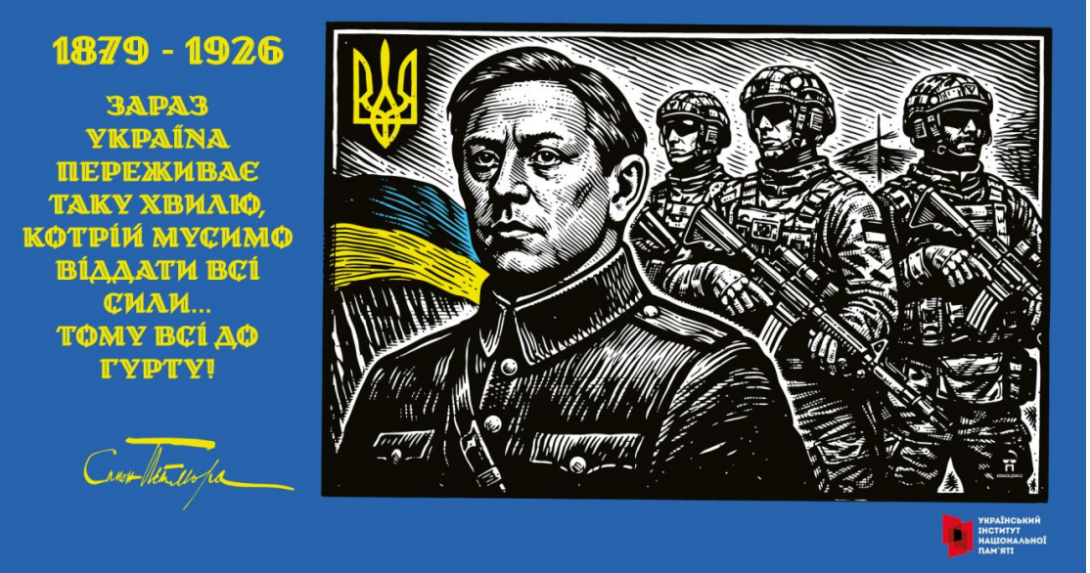
In the conditions of the existential War for Ukraine’s Independence, достойне honoring the memory of Symon Petliura, proper recognition and popularization of his contribution to the creation of the Ukrainian state, culture, and armed forces are of especially great importance. In order to shape the historical consciousness of the Ukrainian people, preserve national memory, and properly mark and honor commemorative dates and anniversaries, on December 18, 2025, the Verkhovna Rada of Ukraine adopted Resolution No. 4748-IX “On the Commemoration of Memorable Dates and Anniversaries in 2026–2027” with Appendix No. 3 “On Measures to Honor the Memory of Symon Petliura,” which stipulates: taking into account Symon Petliura’s exceptional contribution to resistance against Russian aggression and to Ukrainian state-building at the beginning of the twentieth century, in May 2026 events at the state level should be held to mark the 100th anniversary of the day of remembrance of Symon Petliura.
In addition, the action plan approved by the Cabinet of Ministers of Ukraine Order No. 427-r of May 1, 2026, provides for ceremonies, thematic exhibitions, academic conferences, roundtables, memorial, informational-educational, and other events dedicated to the figure of Symon Petliura.
The Ukrainian Institute of National Memory has prepared informational materials on the ideology and substantive content of the relevant thematic events.
At the end of May, Ukraine honors the memory of Symon Petliura: May 22 marks 145 years since his birth, and May 25 marks 100 years since his death at the hands of a Muscovite agent.
Symon Petliura is a symbol of the Ukrainian national liberation movement. As the head of the Ukrainian state, the organizer of the Ukrainian armed forces during the Ukrainian Revolution, and the Chief Otaman of the Army and Fleet of the UNR, he made an exceptional contribution to Ukrainian state-building at the beginning of the twentieth century and to resistance against Russian aggression during the Ukrainian Revolution of 1917–1921.
It was precisely in the confrontation with Bolshevik Russia that Symon Petliura became, for Ukrainians, the embodiment of the idea of freedom, and for enemies, a “bandit” whose name was used for entire generations of followers. Petliurites, like Mazepists and Banderites, inspired fear and hatred among Russians, for it was exactly such powerful personalities as Mazepa, Petliura, and Bandera who awakened in Ukrainians their love of freedom, persistence, and unbreakability.
In Soviet academic publications, textbooks, and dictionaries, “Petliurism” was defined as a “counterrevolutionary bourgeois-nationalist movement in Ukraine during the period of foreign military intervention and civil war, led by one of the leaders of the petty-bourgeois nationalist party of Ukrainian social democrats, Petliura.” Participation in “Petliurism,” that is, in the struggle for an independent Ukraine, long remained grounds for accusations in the USSR. Petliurites were depicted exclusively in negative contexts, given unattractive epithets and unpleasant appearances. The image of Petliurites as saboteurs, traitors, and opponents of the new Soviet government quickly entered Soviet everyday life.
Throughout his life, Symon Petliura fought for Ukrainian independence not only with weapons but also with words: as a journalist, art critic, and editor of leading Ukrainian magazines. In the harshest times of Russian censorship, he organized clandestine printing houses. Even in exile, the UNR leader continued publishing work, founding the journals “Tabir,” “Tryzub,” and others, which turned words into a weapon in the struggle for a free Ukraine.
In 1921, Symon Petliura was forced to leave Ukrainian lands. Yet he did not abandon the political struggle for UNR independence. Soviet special services did not leave Petliura in peace either; they set themselves the goal of disgracing and defaming the name of Symon Petliura and his supporters.
The murder of Symon Petliura made a strong impression on the Ukrainian emigration. UNR government member and diplomat Oleksandr Shulhyn recalled that the event united previously fragmented circles of the Ukrainian emigration. By his life and by his death, Symon Petliura testified that only in unity are Ukrainians able to withstand and win.
One hundred years have passed since Symon Petliura’s death, yet he remains a symbol of the struggle for a free Ukraine. In his honor, toponymic objects are named in populated places, monuments are erected, and murals are painted. Most importantly, the memory of Symon Petliura is immortalized in the modern Ukrainian military.
Soldiers of the UNR Army, and the Chief Otaman himself, wore a sleeve trident on their uniforms. Continuing Petliura’s traditions, the trident became part of the military identity of Ukraine’s Defense Forces. Since 2017, it has been part of Ukrainian soldiers’ uniforms. The 152nd Separate Jaeger Brigade received the honorary name of Symon Petliura. The brigade’s servicemen defend our country on various sectors of the Russian-Ukrainian front.
Historical Background
Of Cossack Lineage
On May 22, 1879, Symon Petliura was born into a family with a history reaching back several centuries. Symon’s great-great-grandfather, Ostap Petliura, was the otaman of the Platnyrivskyi kurin. After the destruction of the Sich in 1775 by order of Empress Catherine II, according to research by Poltava local historian Anatolii Chernov, Ostap “managed to make his way through the Dnipro marshlands to the Samara Monastery. Ostap’s son Omelko painted icons for the Samara Zaporizhzhian Cathedral.” After a horse-breeding plant was founded in Pavlohrad, Omelko Petliura found work there. Later his son Pavlo was born, the grandfather of Symon Petliura. He moved to Poltava, where he organized a carting business, and his son Vasyl inherited and expanded the family enterprise. Vasyl Petliura died in 1909.
The paternal grandmother, Hanna Petliura, née Cholovska, came from a priestly family. After her husband’s death, she took monastic vows and became abbess of the Toplovsky convent in Crimea. Later, in that same monastery, Symon’s sister Yefrosyniia also became a nun; she died tragically in 1918.
The maternal grandfather, Oleksii, after being widowed, also took monastic vows. He joined in founding the Kyiv Ionyn skete. He died in the rank of hieromonk.
His mother Olha grew up in a priestly family of the Marchenko line with Cossack roots. She devoted herself to raising nine children and managing the household. In 1919, she was arrested by the Bolsheviks; after being released, she died on the third day.
Brothers and Sisters
Symon had eight brothers and sisters. All the children received primary education in a parish school. Brothers Ivan, Fedir, Oleksandr, and Symon himself studied at the Poltava Theological Seminary. Only Ivan went further, graduating from the Kyiv Theological Academy. He died of tuberculosis in 1900. Fedir became an agronomist in Kobeliaky county and belonged to the Revolutionary Ukrainian Party. He died under unclear circumstances in 1907. The younger Oleksandr became a soldier. He rose to colonel in the Army of the Ukrainian People’s Republic. After the Soviet occupation of Ukrainian lands, he ended up in Canada, where he passed away in 1951. The fates of the Petliura sisters differed. Tetiana became the wife of a candle-factory owner. Maryna and Feodosiia lived in Poltava all their lives. In 1924, Chekists arrested them for the first time, but released them. In 1927, the sisters managed to regain their previously nationalized parental house. In 1937, the sisters were arrested again, along with their nephew Sylvestr Skrypnyk, Marianna’s son, brother of Patriarch Mstyslav (Stepan Skrypnyk) of Kyiv and All Ukraine of the Ukrainian Autocephalous Orthodox Church. On November 19 of that same year, all three were shot by decision of the “troika.”
The UNR “First Lady”
Family support and inner balance for Symon Petliura in times of great upheaval came from his wife Olha and daughter Lesia. It was the family that remained for him the space where he could find peace and restore strength.
Olha Bilska was born on December 23, 1885, in the village of Mala Divytsia, Poltava Governorate. She was orphaned early, and her grandmother raised her. She graduated with honors from the Pryluky Women’s Gymnasium with the qualification of home teacher. She moved to Kyiv, where she worked at Zherebetska’s private gymnasium.
In 1908, while visiting distant relatives in Kyiv, she met Petliura. She met him again at a party of the Ukrainian student community in Moscow. Love flared up between the two young people, university student Olha and accountant of a transport society, publisher of the journal “Ukrainskaya Zhizn” (“Ukrainian Life”), Symon. The couple took an active part in the life of the Ukrainian diaspora in Moscow: they organized concerts, literary evenings, etc. Since 1910, they lived in a civil marriage. On October 25, 1911, their daughter Lesia was born. The couple had a church wedding on January 18, 1915.
Since 1917, the family was in Kyiv. Olha, together with her husband, plunged into the whirlwind of the Ukrainian Revolution. She participated in women’s associations and cared for the wounded in hospitals. In January 1918, shortly before the seizure by the army of Soviet Russia, the UNR leadership left the capital. Olha remained in Kyiv with her seven-year-old daughter. They lived under a false surname and often changed places of residence, escaping persecution.
In 1919, Petliura’s friends helped his family emigrate. At first Olha lived in Krakow, later she moved to Warsaw to join her husband. On October 16, 1924, Petliura moved to Paris, but his wife and daughter arrived there a year later, when Lesia finished the third grade of secondary school. To pay for her daughter’s private tutors, Olha earned money by embroidery. Her husband’s murder undermined her health: she quickly lost hearing and sight… She passed away on November 23, 1959. She was buried next to her husband.
Poet Lesia
The Petliuras named their only daughter Larysa (Lesia) in honor of Lesia Ukrainka. The girl grew up in an environment where Ukrainian traditions prevailed. In childhood Lesia wore traditional Ukrainian clothing and was a member of
“Plast.”
In 1920–1922, she studied in Prague, where she mastered Czech. Poet and translator Maksym Slavynskyi, who knew Lesia Ukrainka closely, helped her explore Lesia Ukrainka’s works. In Czechoslovakia, she befriended the writer’s family of Vasyl Koroliv-Staryi and his wife Natalena Koroleva. In Poland she became friends with artist Viktor Tsymbal.
She took her father’s murder very hard. Life hardships caused tuberculosis. Her mother took her daughter to a sanatorium in Cambo-les-Bains, hoping the air of the Pyrenees would help overcome the illness. The most painful part was that doctors forbade studying. She had to continue education remotely. In letters and notes, she recorded interesting details of contemporary European life, especially in Czechia and France, and observations on culture and literature. She contributed to the Ukrainian magazine “Molode Zhyttia” (“Young Life”). Lesia Petliura’s notable giftedness is evidenced by her creative legacy: poems, articles, epistolary writings, and drawings.
Lesia Petliura died on November 6, 1941. She was buried with her father and mother at Montparnasse Cemetery in Paris.
Revolutionary Youth: From Seminarian to Rebel
Throughout his life, Symon Petliura fought for Ukrainian independence with words: as a journalist, art critic, and editor of leading Ukrainian magazines. In the harshest times of Russian censorship, he organized clandestine printing houses. And he entered the path of revolutionary journalism thanks to a song. In 1901, during Shevchenko celebrations in Poltava, where Petliura was studying at the theological seminary, Mykola Lysenko arrived; the music-loving seminarian invited the composer to hear the seminary choir under his direction perform Lysenko’s cantata “Byut porohy” (“The Rapids Roar”) on words by Taras Shevchenko. The seminary rector burst into the unauthorized concert, accused Lysenko of a “Mazepist intrigue,” and Petliura was expelled from his final seminary year.
From Kuban to Lviv
In 1902, Symon Petliura moved to Kuban, where he and like-minded people founded an underground printing house to distribute revolutionary appeals to the population. He researched the archive of the Zaporizhzhian Cossacks, and this is how his journalistic career began. He sent his first publications to the Lviv-based “Literaturno-naukovyi visnyk.” He wrote mostly about culture: education and theater, archaeological finds, Kuban expeditions of Oleksandr Koshyts, later known as the
“godfather of Shchedryk.” He criticized the Russian Church as an instrument of the Tsarist Russification policy.
In 1905, Symon Petliura moved to Lviv, where he worked as co-editor of the periodicals of the Revolutionary Ukrainian Party “Selianyn” and “Pratsia.” In 1906 in Saint Petersburg he edited the journal “Vilna Ukraina” (“Free Ukraine”). In 1907 he became secretary of the newspaper “Rada” in Kyiv. Besides socio-political journalism, Petliura wrote reviews of Ukrainian and foreign books, published music and theater overviews, and printed jubilee dedications to cultural figures. In parallel, he headed the theater section in the journal “Ukraina,” became editor-in-chief of the newspaper “Slovo,” and literary manager at Mykola Sadovskyi’s theater.
“Ukrainian Life” in Moscow
Since 1910, already a known journalist, he moved to Moscow, where he headed a printed tribune of Ukrainianness in the heart of a hostile empire, the journal “Ukrainskaya Zhizn” (“Ukrainian Life”). During 1912–1916, as editor, he worked with the best Ukrainian authors. He wrote himself, again much about culture. In 1914 he prepared an entire issue for the 100th anniversary of Taras Shevchenko. When in 1917 Petliura returned again to Kyiv and headed the UNR military ministry, he did not forget culture there either. In one appeal to the population, he asked citizens to donate money to purchase Ukrainian literature for the front.
In exile, the UNR leader continued his publishing work. From 1923 he founded and edited the journals “Tabir,” “Tryzub,” and others, which even after Symon Petliura’s death became for Ukrainians scattered across the world an opportunity to turn words into a weapon in the struggle for a free Ukraine.
In the First World War
During wartime, Symon Petliura issued a statement that Ukrainians, being subjects of the Russian Empire, should loyally fulfill their duty to it, and he expressed hope that in the future the Tsarist authorities’ attitude toward the Ukrainian question would change. At the beginning of 1916, he entered service in the All-Russian Union of Zemstvos, serving as commissioner of the main All-Russian Zemstvo Congress and head of the Control Collegium of the Zemstvo Union on the Western Front.
At the head of the Ukrainian military movement
After the overthrow of Russian autocracy, he initiated and organized in April 1917 in Minsk the Congress of the Ukrainian Western Front. He was elected chairman of the Ukrainian Front Council and delegated to the First All-Ukrainian Military Congress, held May 18–21, 1917, in Kyiv.
Based on Petliura’s report, a resolution “On the Ukrainization of the Army” was adopted, and the need was declared to demand that the Provisional Government recognize Ukraine’s autonomy.
After the congress, Petliura was elected to the Ukrainian General Military Committee, created to coordinate the Ukrainian military movement and expand Ukrainization of military units of the Russian army and navy. The committee was subordinate only to the Ukrainian Central Rada (UCR) and recognized no Russian authority over it. Petliura headed it and joined the UCR.
General Secretary of Military Affairs
At the Second All-Ukrainian Military Congress in Kyiv in June 1917, he advocated creating a large Ukrainian army, while seeing danger in it. With his participation, the UCR adopted the First Universal, proclaiming Ukraine’s autonomy within Russia.
In the General Secretariat created by the UCR on June 28, 1917, its executive body, Symon was elected General Secretary of Military Affairs.
His main task was the Ukrainization of the army. While working on creating Ukrainian military units, he met resistance from the Russian government and pro-Russian forces, as well as from part of the Council members who took a pacifist position.
He was part of the delegation that negotiated with the Ukrainian Volunteer Regiment named after Hetman Pavlo Polubotok. The Polubotkivtsi opposed the UCR’s Second Universal and concessions to Petrograd authorities, demanding that all power belong precisely to the Central Rada. Petliura urged soldiers not to take the path of anarchy so as not to disrupt the army Ukrainization plan.
On November 2–13, 1917, he was an active participant in the Third All-Ukrainian Military Congress in Kyiv, which demanded that the UCR immediately proclaim the Ukrainian People’s Republic, fully Ukrainize the army and navy, and conclude peace.
After the Bolshevik coup on November 7, 1917, Symon Petliura resolutely stood to defend the country from the authority of both supporters of the Provisional Government and Bolsheviks. Already on November 13, he ordered Ukrainian troops to occupy all the most important government facilities in Kyiv.
On November 20, the UCR proclaimed the Ukrainian People’s Republic, and at that time Petliura organized the Serdiuk divisions and led the disarmament by Ukrainian troops of pro-Bolshevik units and Red Guard fighters in the capital.
From Ministerial Post to Volunteer Formation
In December 1917, Bolshevik Russia began a war of conquest against the Ukrainian People’s Republic (UNR).
On the last day of 1917, in protest against the pro-Bolshevik orientation of General Secretariat head Vynnychenko, Petliura left the government.
In early January 1918, he headed the Haidamaka Kosh of Slobidska Ukraine. In Kyiv, from volunteers of the Second Infantry Cadet School, he formed a kurin of Black Haidamaks (up to 150 soldiers), which joined the Kosh.
In the Fight Against the Bolsheviks
At the head of the Haidamaks, he fought against Bolshevik troops. The first baptism of fire took place in Poltava region in battles for Hrebinka.
Later, the Kosh joined suppressing the January Bolshevik uprising in the capital. Petliura took part in defensive battles in Kyiv against the onslaught of Bolshevik troops of Mykhailo Muravyov.
On February 9, 1918, in Brest (Brest-Litovsk), the UNR on one side and Germany, Austria-Hungary, Turkey, and Bulgaria on the other signed a peace treaty by which the Quadruple Alliance recognized the UNR and provided armed assistance in fighting the external aggressor.
After Ukrainian troops retreated from the capital on the night before February 10, 1918, a reorganization took place in the town of Hnativka. All units were merged into a Separate Zaporizhzhian Detachment. Together with it, the effectively revived, battle-hardened, motivated Ukrainian army also included the Kosh headed by Symon Petliura and the First kurin of Sich Riflemen under Yevhen Konovalets.
Petliura’s Haidamaks, together with other Ukrainian units and allied German and Austro-Hungarian troops, went on the offensive against the Bolshevik aggressor. They were the first to enter the capital, and after its liberation held a victory parade.
The Kosh became one of the most combat-capable Ukrainian units. The soldiers with whom Petliura fought shoulder to shoulder in battles for Ukraine’s independence remained his associates and trusted persons. These were Oleksandr Udovychenko, Mykola Chebotariv, Serhii Delvig, and Omelian Volokh. However, as the example of the latter showed, not all justified his trust.
At the end of March 1918, under pressure of circumstances, Petliura was forced to leave military service and headed the Kyiv provincial zemstvo; a month later he created and headed the All-Ukrainian Union of Zemstvos.
Head of the Directory. The Road to Unity
On December 19, 1918, insurgent troops ceremonially entered Kyiv, meaning restoration of the authority of the Ukrainian People’s Republic. An important step was the proclamation on January 22, 1919, of the Universal on unification of the UNR with the West Ukrainian People’s Republic, which had emerged in November 1918 in Lviv. The Act of Unity aimed to unite Ukrainian lands in one state.
Yet already then, the Ukrainian state found itself before a new wave of external aggression. At the end of 1918 and beginning of 1919, Soviet Russia launched a second war against the UNR. In these circumstances, Symon Petliura assumed a key role in preserving Ukrainian statehood. As early as January, at a meeting of the Directory, representatives of political parties and troops, Petliura sharply spoke out against the Bolsheviks. He repeatedly stated that to defend Ukraine and build statehood, a strong army was necessary.
“The State Above Parties”
On February 5, 1919, the Red Army captured Kyiv for the second time. Government institutions were evacuated from the city. Directory chairman Vynnychenko left state leadership and went abroad. On February 11 in Vinnytsia, Symon Petliura became the de facto sole leader of Ukraine, combining the posts of head of the Directory and Chief Otaman of the Army. To distance himself from narrow party interests, he left the Ukrainian Social Democratic Labor Party and positioned himself as being “above parties.”
During 1919, the UNR government found itself at war on several fronts: against Bolshevik forces and the Volunteer Army of General Anton Denikin, which advocated restoring “one and indivisible Russia.” Despite this, Petliura led military and political resistance, seeking to preserve the UNR’s international
subjectivity. He paid significant attention to diplomatic contacts with Entente states, as well as negotiations with Romania and Poland.
In the “Triangle of Death”
By the end of 1919, the UNR Army, drained by battles and a typhus epidemic, found itself in the “triangle of death” in the Liubar–Chortoryia–Myropil area. In the north and east they were opposed by the Reds, in the south by the Whites, and in the west by the Polish army.
Ultimately, two paths remained for salvation: cross the Ukrainian-Polish border and lay down arms, or switch to partisan methods of struggle. On December 5, the high command of the UNR troops decided to begin the First Winter Campaign of the UNR Army and approved Symon Petliura’s departure to Warsaw to complete political negotiations with Poland.
Ukrainians and Jews: The Tragedy of Provoked Hatred
The late nineteenth and early twentieth centuries were marked by a wave of pogroms against the Jewish population in Ukraine. Among the causes were propaganda of the Russian Empire, which shaped stereotypical views of Jewish life among Ukrainian peasants; the negative image of the “Jew-Bolshevik,” spread by political movements hostile to Soviet power; and absence of centralized authority during the Ukrainian Revolution.
According to Canadian researcher Henry Abramson, representatives of antagonistic ethnic groups (Jews and Ukrainians) attempted to establish effective political relations.
In Respect and Sympathy
A native of Poltava, Symon Petliura grew up in the environment of an imperial provincial center where Poles, Russians, Jews, and Ukrainians coexisted. As a young participant in the Ukrainian civic movement, he was interested in the life of other ethnic groups; in his own texts he condemned Jewish pogroms and deprivation of Jews’ opportunities for education and political activity, and promoted publications devoted to local imperial minorities. In particular, he wrote a preface to the play “Jews” by playwright Yevhen Chyrykov about a pogrom in the city of Iași.
Ministry of Jewish Affairs
As one of the leaders of the UNR Directory, and later its sole leader, Petliura actively built interethnic relations. Jewish national-personal autonomy was restored: local authority was transferred to public assemblies (kehillas), and the newly created Ministry of Jewish Affairs entered the main executive body of the Directory, the Council of People’s Ministers of the UNR. Yiddish became one of the official languages. Figures of Jewish origin held positions in the Directory’s executive institutions.
Soldiers and officers of Jewish origin took part in the campaign on Kyiv in summer 1919, the Polish-Bolshevik war of 1920–1921, and the First and Second Winter Campaigns.
With support of the Head of the Directory, Jewish education and culture developed. At Kamianets-Podilskyi University, a department of Jewish history and literature was established. With state and private funds, a system of teacher and “Froebel” (educator) courses was developed; primary and secondary schools and kindergartens were restored. In cooperation with Jewish educational initiatives (“Kultur-Lige”), several national acting troupes were created in the local theater.
Representatives of Jewish communities were involved in the newly created Extraordinary Commission that investigated facts of pogroms, and victims were provided appropriate monetary compensation or had lost property returned.
Ukrainian-Jewish Relations During Emigration
In emigration, Petliura closely followed the political and social life of national minorities. Together with figures of the Zionist movement, a project to create Jewish armed formations on the territory of Ukraine was agreed. On September 4, 1921, during preparations for the Second Winter Campaign, the Karlsbad Agreement was concluded, providing for formation of Jewish military organizations for self-defense on Ukrainian territory liberated from the Bolsheviks. On behalf of the Directory, Maksym Slavynskyi signed, and on the other side, Volodymyr Jabotinsky.
Song as Weapon: UNR Cultural Diplomacy
To secure international recognition and support for Ukraine from the Western world in the war with Russia, in January 1919 Symon Petliura initiated a cultural diplomacy project by sending the Ukrainian Republican Capella abroad. He was inspired by the song “Legend” by Mykola Leontovych to verses by Mykola Voronyi, performed at the poet’s creative jubilee by a choir under Oleksandr Koshyts. The composition so impressed the Supreme Commander-in-Chief of the UNR Army that he immediately instructed the conductor to go on tour to Paris. At that time, sessions of the Paris Peace Conference were beginning in France, where leaders of the First World War victors were redrawing the postwar map of the world. Symon Petliura hoped that, according to U.S. President Woodrow Wilson’s declared right of nations to self-determination, Ukraine’s right to independence would also be recognized.
Triumphal Tours
In 1919–1924, under the Maestro’s direction, the capella performed in more than 200 cities across 17 countries in Europe and America. Concerts were attended by queens, presidents, famous cultural figures, and art critics. All admired Ukrainian songs arranged by Mykola Lysenko, Mykola Leontovych, Kyrylo Stetsenko, and Oleksandr Koshyts. The hit of the tour was Mykola Leontovych’s “Shchedryk.” Everywhere audiences asked for encores, and halls resounded with “Vive l`Ukraine!”
“A masterpiece of folk art,” they wrote about the composer’s pearl in Brussels. “The best song in the repertoire,” London critics noted. “Whoever has experienced the beautiful singing of the Ukrainian Republican Capella cannot fail to love Ukraine with all their soul,” Prague professors concluded.
Symon Petliura corresponded with the singers throughout their tour and personally lobbied financing for the choir during the war for Ukraine’s independence. Impressed Dutch critics called him “a commander-in-chief in love with art.” Yet Western politicians still did not recognize Ukraine.
From “Shchedryk” to “Carol of the Bells”
In 1922, Oleksandr Koshyts’s choir moved to America. Symon Petliura continued in letters to ask the Maestro to carry Ukrainian independence to the world through song. On October 5, 1922, the choir triumphed at New York’s
“Carnegie Hall”: “Shchedryk” sounded on the American continent for the first time. In 1936, an English-language version of the composition appeared, the carol “Carol of the Bells,” now sung worldwide at Christmas. The idea of Symon Petliura, who all his life was captivated by Ukrainian songs and in wartime invested in culture, fulfilled Taras Shevchenko’s testament: “Our thought, our song will not die, will not perish... There, people, is our glory, the glory of Ukraine!”
The Petliura-Pilsudski Alliance
Russian imperialist encroachments on the independence of Ukraine and Poland forced both sides to negotiate. The Ukrainian elite had to choose: stop the liberation struggle for independence, or continue the struggle by concluding a treaty and ceding territories. Petliura chose the latter. Negotiations ended with the signing of the Warsaw Treaty, known as the Petliura-Pilsudski alliance. In exchange for recognition of UNR independence and military aid, Galicia and Western Volhynia were ceded to Poland. “It was a forced concession aimed at preserving statehood in the remaining territory,” historian Professor Vladyslav Verstiuk is convinced.
1920: In Defense of Europe
Allied armies of the two states advanced into the Dnipro region against the Red Russian occupiers. The military campaign initially unfolded successfully. On May 7, 1920, Polish and Ukrainian troops entered Kyiv, the capital of the UNR, and pushed the Bolsheviks beyond the Dnipro. On May 9, a parade of Ukrainian and Polish troops marched down Khreshchatyk.
Later the Red Army seized strategic initiative and occupied Kyiv. In July, Semyon Budyonny’s First Cavalry Army broke through to Lviv, and in August this force already stood near Warsaw. “The Miracle on the Vistula” is the name under which the defense of Warsaw entered history. The victorious battle in the suburbs of the Polish capital saved its independence and prevented its transformation into another Soviet republic. Soldiers of the 6th Rifle Division of the UNR Army under Marko Bezruchko displayed heroism, self-sacrifice, and military skill.
The Polish leadership supported the UNR government in exile, created living conditions for interned UNR Army servicemen, and received insurgent otamans fleeing Bolshevik persecution.
November Raid of 1921
In November 1920, Ukraine came under Bolshevik control. The UNR Directory moved to Tarnow, Poland. In January of the following year, Petliura gathered senior officers of the UNR Army to create a Partisan-Insurgent Headquarters to organize the campaign known as the November Raid, or the Second Winter Campaign. It took place in October-November 1921 in three groups. The Podillia group under Mykhailo Palii-Sydorianskyi, after defeating several Red cavalry units, reached Borodianka in Kyiv region, but, not meeting the main forces, returned to Poland. Yurii Tiutiunnyk’s Volhynian group eliminated several small Bolshevik detachments, but was defeated by Kotovsky’s cavalry in Zhytomyr region, and 360 soldiers were shot near the village of Bazar on November 21, 1921. The Bessarabian group of Andrii Hulyi-Hulenko set out last. Having crossed the Dniester, it occupied several border villages and part of Tiraspol, but was forced to retreat to Romania. The Second Winter Campaign demonstrated Ukrainians’ readiness to gain statehood at any cost.
Warsaw - Budapest - Vienna - Geneva - Paris
After the Second Winter Campaign, Ukrainians massively left the Dnipro region. Symon Petliura understood that the internal life of Ukrainians abroad had to be organized, so he cared for creating emigration institutions.
Because of the hunt for him by Moscow agents, he was forced to move frequently and each time rebuild his own everyday life from scratch. Eventually, in autumn 1924, he reached Paris.
At the Head of the UNR State Center in Exile: The Struggle Continues
Wherever he stayed, the Chief Otaman engaged in journalism, and most importantly led the government in emigration. The émigré government of the Ukrainian People’s Republic was established in 1921 in Poland, then underwent various transformations until in 1924 in Paris it received the name State Center of the UNR. The Center directed efforts so that world states would recognize it and provide material, moral, and military support, primarily to intelligence, military, and informational actions against the communist regime.
Thanks to Petliura’s organizational talents, the UNR State Center became a hub of the long struggle of the Ukrainian people for a national state.
After the murder of the Chief Otaman, the UNR State Center moved to France, Germany, and the USA, and when Ukraine restored independence on August 24, 1991, having fulfilled its mission, it relinquished its powers. This happened on August 22, 1992.
Murder in the Latin Quarter
In May 1926, Polish and Ukrainian political circles began speaking about a new campaign against the Soviets. This was linked to Józef Piłsudski’s return to power in Poland and possible restoration of alliance with Symon Petliura. For Soviet authorities, Petliura became an even more dangerous opponent, and this pushed the communists toward his physical elimination.
On May 25, 1926, around 1 p.m., Symon Petliura was walking to lunch at the “Bouillon-Chartier” restaurant on Racine Street near the hotel where he lived. An hour later he came out and was looking at a book stall at the corner of Racine Street and Boulevard Saint-Michel. A man approached him and shot him with a revolver. Five of seven bullets hit his body. The killer, Samuil Schwarzbard, surrendered to a policeman who ran to the scene. According to another version, passersby first seized the shooter, intending lynching, but then handed him to police.
Wounded Symon Petliura was taken to the nearest clinic, “Charité,” where he died shortly afterward. On May 30, 1926, he was buried at Montparnasse Cemetery.
Trial of the Murderer
During interrogation, Samuil Schwarzbard claimed the murder was revenge for Jewish pogroms in Ukraine. During arrest, a list of Ukrainian political figures was found on him, hinting that Petliura might not have been the only target. It is known that Schwarzbard had previously lived in Odesa, was a member of the Communist Party, and later became a French communist.
The thesis of “Petliura as chief organizer of pogroms” formed under influence of a book tendentiously compiled with assistance of Soviet bodies, published in France on the eve of the trial by Schwarzbard’s lawyer, socialist Henri Torrès, close to communist circles. French newspapers described Petliura as a “Ukrainian general guilty of massacres,” shaping public opinion not in Petliura’s favor, while Soviet special services actively spread these materials in the foreign press.
The trial of Schwarzbard took place in Paris in 1927. Schwarzbard was charged with premeditated murder, punishable by death. Prosecutor was lawyer Maurice Garçon; murderer was defended by Henri Torrès. Despite documents presented at trial proving Petliura and his government tried to stop pogroms, the judge’s decision was influenced by the jury’s position: “Acquit the accused.” The verdict was announced on October 26, 1927: Petliura’s widow was ordered to pay a fine of 1 franc for work of municipal services that washed her husband’s blood from the asphalt. Schwarzbard was released. The French public met this finale with applause.
The trial was used by Soviet propaganda. The murderer was made a “people’s avenger,” while Petliura became a “pogromist.” This damaged the reputation of the Ukrainian liberation struggle in the West.
Moscow Propaganda Against Petliura
In 1921, Symon Petliura was forced to leave Ukrainian lands. Yet he did not abandon the political struggle for UNR independence. Soviet special services did not leave Petliura in peace; they made it their goal to discredit and defame the name of Symon Petliura and his supporters.
One key tool in propaganda’s arsenal was cinema. In 1926, at the Odesa Film Studio, directors Axel Lundin and Heorhii Stabovyi created the film “P. K. P.” (“Piłsudski Bought Petliura”). The film’s plot tells about the final period of the Directory’s struggle with the Bolsheviks, from signing the Warsaw Treaty to the Second Winter Campaign. Real participants of those events were involved in making the film: Hryhorii Kotovsky, fighters of his unit, and even, through deception, captured UNR commander Yurii Tiutiunnyk, to create the feeling of watching not a feature film but a historical chronicle. In the plot, Petliura appears as a self-loving tyrant, anti-Semite, and bribe-taker, and every phrase or action put into his role by the screenwriters only reinforces this effect.
This was not Petliura’s last appearance on screen; the image of Petliura would appear dozens more times in films, including in Oleksandr Dovzhenko’s “Shchors” (1939). However, the foundations of this new image of Petliura were laid precisely in “P. K. P.” under the close watch of the GPU in the person of Vsevolod Balytskyi, People’s Commissar of Internal Affairs of the Ukrainian SSR.
In the Crosshairs of Cartoonists’ Pens
For more than 50 years, Petliura and Petliurites became permanent characters of caricatures that filled publications such as “Chervonyi Perets,” and the image of the Petliurite as a saboteur, traitor, and opponent of the new Soviet government quickly entered everyday life. In works of fiction, Petliura and Petliurites were depicted exclusively in negative contexts, given unattractive epithets and unpleasant appearance. In academic publications, textbooks, and dictionaries, “Petliurism” was defined as a “counterrevolutionary bourgeois-nationalist movement in Ukraine during the period of foreign military intervention and civil war, led by one of the leaders of the petty-bourgeois nationalist party of Ukrainian social democrats, Petliura.” Participation in
“Petliurism,” that is, in the struggle for an independent Ukraine, long remained grounds for accusations in the USSR. Thus, in 1930, in the show trial of the Union for the Liberation of Ukraine, hundreds of people were accused; and in 1948, Oleksandr Hrekov, former general of the UNR Army, was sentenced to 25 years for this. Petliura himself in the “Great Soviet Encyclopedia” appears as a coachman’s son expelled from seminary, who constantly had problems with the law until he himself came to power. Mandatory in all definitions was mention of allegedly organized Jewish pogroms by Petliura and alliance with Poland.
Symbol of the Struggle for a Free Ukraine
... in bronze and granite
On October 14, 2001, a monument to Symon Petliura appeared in Rivne. This granite and bronze bust was for a long time the only one in the country, until on August 24, 2018, a bust of Symon Petliura appeared on the boulevard in Ternopil bearing his name.
On October 14, 2017, in Vinnytsia near the building where the Chief Otaman’s Field Chancellery had been located, a monument to the UNR leader was ceremonially unveiled. The sculpture reproduces a historical photo taken in 1919 in Kamianets-Podilskyi.
The story of installing a monument to Symon Petliura in his birth city Poltava and in the capital has continued for several decades. Two presidential decrees, public statements by officials and politicians did not move the matter in Kyiv.
Instead, in Poltava, the initiative voiced in 1992 at the First All-Ukrainian Scholarly Petliura Readings by the last President of the UNR in exile, Mykola Plaviuk, and Sixtier Mykola Kulchynskyi, finally took clear shape in 2021: an architectural competition was held and a place for the monument was determined.
For the centenary of the Warsaw Battle, in the Polish city of Skierniewice, a collective monument was installed to UNR leader Symon Petliura, Polish leader Józef Piłsudski, Hungarian Prime Minister Pál Teleki, and Charles de Gaulle, then a military adviser. Today this is the only monument to Petliura outside Ukraine.
The memory of Symon Petliura is immortalized on memorial plaques in various cities and towns of Ukraine. Kyiv, like Poltava, now has two each. Memorial plaques honoring Petliura personally or events in which he participated exist in Khmelnytskyi, Kamianets-Podilskyi, Bila Tserkva, Ternopil, Fastiv, etc.
... in toponymy
Symon Petliura’s name is immortalized in more than 90 place names across the country. The return of his name to symbolic space occurred mainly since 2014, that is, under the influence of decommunization and decolonization reforms.
... in eternity
The UNR leader passed into eternity in the “Charité” clinic in Paris, as attested by memorial plaques in Ukrainian and French on both sides of the entrance to Saint Volodymyr Church. Petliura’s funeral service was held in a Romanian Orthodox church, and he was buried at Paris’s Montparnasse Cemetery.
The murder of Symon Petliura made a strong impression on Ukrainian emigration. UNR government member and diplomat Oleksandr Shulhyn recalled that the event united previously fragmented circles of Ukrainian emigration. By his life and by his death, Symon Petliura testified that only in unity are Ukrainians able to withstand and win.