

April 26, 1986 was the day of the greatest man-made disaster in human history. During an experiment on the 4th reactor of the Chornobyl Nuclear Power Plant, two explosions occurred. A cloud of radioactive dust was released into the Earth's atmosphere. The wind carried dangerous radioactive isotopes to the northwest, where they settled on the ground and penetrated water sources. Ukraine ranks first among the former Soviet republics in the number of casualties. Belarus received approximately 60% of the harmful emissions. Russia also suffered heavily from radioactive contamination. A powerful cyclone carried radioactive substances across Lithuania, Latvia, Poland, Sweden, Norway, Austria, Finland, Great Britain, and later Germany, the Netherlands, and Belgium.
It has been 40 years since the Chornobyl Nuclear Power Plant accident, yet its consequences are still being discussed by the global scientific community. According to UNSCEAR and WHO definitions, the Chornobyl disaster is classified as the highest-level nuclear facility accident. Historians, meanwhile, emphasize the political responsibility of the communist regime, which, in the name of ideological interests, jeopardized the lives and health of millions of citizens. Due to design flaws, construction technology violations, and the use of substandard building materials, such a man-made disaster became inevitable. The criminal concealment of information by the authorities, on one hand, deepened the irreversible negative consequences of the accident and, on the other, triggered the activation of environmental and national-democratic movements, which ultimately led to the collapse of the USSR.
This year, thematic banners for public service advertising were created on commission by the Institute (author — Andriy Yermolenko). They are available at the following link:
https://mega.nz/folder/x5pDTRaI#XRXknvD-Ay_0khh9hzfoHw
The Chornobyl Nuclear Power Plant accident led to public health and demographic problems, as well as irreversible economic, social, and humanitarian consequences. In terms of environmental impact, the accident grew into a planetary catastrophe: radioactive cesium contaminated 3/4 of Europe's territory.
At the time, the Soviet Union had proclaimed glasnost and openness. However, the emergency at the Chornobyl NPP exposed the hollowness of these slogans. Understanding that an ecological catastrophe of such magnitude would have negative consequences for the communist regime, the USSR leadership chose to suppress information about it, and all information about the disaster immediately fell under the ideological control of the Communist Party and the KGB.
The Chornobyl tragedy demonstrated the unwillingness of the state leadership to subordinate political interests to the humanistic values of human life and health. To show that there was no radiation danger, the party leadership did not cancel the May Day parade. Hundreds of thousands of people, including schoolchildren, were brought out onto Khreshchatyk five days after the accident. The next day, all newspapers were full of celebratory reports. Meanwhile, even cautious safety recommendations from the Minister of Health only managed to appear as late as May 9!
The Ukrainian diaspora demonstrated a high level of civic engagement and activism after the Chornobyl accident. It organized demonstrations, prepared appeals to Western governments, and collected materials about the tragedy. The Foreign Directorate of the Ukrainian Supreme Liberation Council made significant efforts in September 1986 to bring the Chornobyl issue before the United Nations.
The Chornobyl disaster became one of the catalysts for the collapse of the USSR. Moscow's attempts to conceal the truth about its consequences, the inadequate safety measures, and the insufficient assistance to victims shook the faith in the "humaneness" of the communist idea even among its most loyal supporters. The Soviet government demonstrated a glaring disregard for the fate of its people.
In the post-accident period, environmental and national-democratic movements, primarily in Ukraine, intensified. On April 26, 1988, the first unauthorized demonstration in Kyiv took place under the slogans: "Remove Nuclear Power Plants from Ukraine," "Ukrainian Cultural Club — for a Nuclear-Free Ukraine," "We Don't Want Dead Zones," "Nuclear Power Plants — to a Referendum," "Industry, Land, Water — Under Environmental Control," "A Personal Dosimeter for Everyone." In many regions, both in the east and west, people took to the streets to protest against the construction of new nuclear power plants and the operation of existing ones. The first civic organizations were formed precisely around the issue of the nuclear catastrophe, and they evolved into political forces — for example, "Green World" and the "Chornobyl" Union.
The Chornobyl Disaster in Numbers and Dates
In 1977, the first unit of the Chornobyl Nuclear Power Plant was launched.
2 years — the fourth power unit of the Chornobyl NPP had been in operation when it was launched at full capacity in 1984. It was the "youngest" and most modern reactor.
2 days — the world knew nothing about the explosion.
30 NPP employees died as a result of the explosion or acute radiation sickness within a few months of the accident.
500,000 people died from radiation, according to independent experts' estimates.
8.5 million residents of Ukraine, Belarus, and Russia received significant radiation doses in the days immediately following the accident.
90,784 people were evacuated from 81 populated areas of Ukraine by the end of summer 1986.
Over 600,000 people became liquidators of the accident — fighting fires and clearing debris.
2,293 Ukrainian cities and towns with a population of approximately 2.6 million people were contaminated with radioactive nuclides.
200,000 square kilometers — the area over which radiation spread. Of these, 52,000 square kilometers were agricultural lands.
10 days — from April 26 to May 6 — the release of radioactivity from the damaged reactor continued at tens of millions of curies per day, after which it decreased by thousands of times. Experts call this period the active phase of the accident.
11 tons of nuclear fuel were released into the atmosphere as a result of the accident at the 4th power unit of the Chornobyl NPP.
400 species of animals, birds, and fish, and 1,200 species of flora continue to exist in the "exclusion zone," where humans are prohibited from living due to severe and catastrophic contamination of air, soil, and water.
From April 26 to October 1986, the Chornobyl NPP was not operating. In October 1986, units 1 and 2 were put back into service; in December 1987, unit 3 resumed operation. Unit 4 never restarted.
1991 — a fire broke out at unit 2, which blocked the operation of that reactor.
December 1995 — a memorandum was signed between Ukraine and the G7 countries and the European Union Commission, under which preparations began for a program to fully close the plant.
December 15, 2000 — the Chornobyl Nuclear Power Plant was shut down completely.
September 2010 — the foundation for the new sarcophagus over the destroyed 4th power unit was laid; in April 2012, construction of the arch designed to cover the "Shelter" began; in October 2011, construction of the Centralized Storage Facility for Spent Ionizing Radiation Sources began at the "Vector" complex.
November 29, 2016 — the sliding of the arch over the 4th power unit was completed.
February 14, 2025 — a Russian "Shahed" (Geran-2) strike drone damaged the shelter over the 4th power unit of the Chornobyl NPP.
Historical Background
What happened on the night of April 26, 1986?
On April 25, 1986, the Chornobyl NPP was scheduled to experimentally shut down the fourth power unit in order to study the possibility of using the turbogenerator's inertia in the event of a power loss. Despite the fact that technical circumstances did not match the test plan, it was not cancelled.
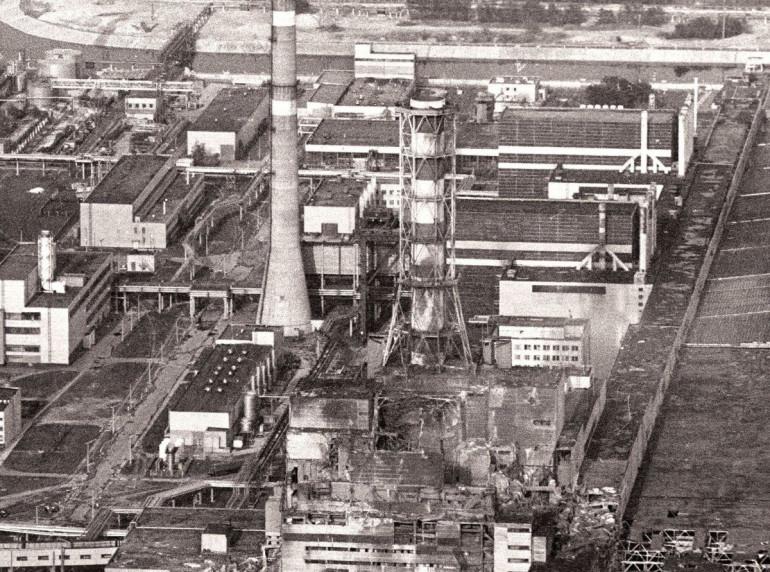
The experiment began on April 26 at 01:23. The situation spiraled out of control. At 01:25, two explosions thundered within a few seconds of each other. The reactor was completely destroyed (Document 1). Over 30 fires broke out. The main fires were extinguished within an hour, and the fire was fully put out by 5:00 a.m. on April 26. However, an intense fire later broke out in the central hall of unit 4, which was fought using helicopter equipment until May 10.
At the time of the accident, 17 workers were present in the 4th power unit. Senior reactor operator Valery Khodemchuk was killed under the rubble. On the day of April 26, maintenance worker Volodymyr Shashenok died from radiation exposure. 11 workers received radiation doses. All of them died of radiation sickness before May 20, 1986, in Moscow's Hospital No. 6. Another 14 plant personnel received doses that caused 3rd and 4th degree radiation sickness.
The day after the accident, the government commission made the decision to immediately shut down units 1 and 2 and to evacuate the population of Prypiat (the so-called 10-kilometer zone).
A KGB report states that as of 8:00 a.m. on April 28, radiation levels at units 3 and 4 were 1,000–2,600 microroentgens per second, and in certain parts of the city — 30–160. At this point in the document, Volodymyr Shcherbytsky made his now famous annotation — "What does this mean?" This eloquently demonstrates that even the highest-ranking officials did not fully comprehend the danger.
Military personnel were immediately deployed for clean-up operations. The first to arrive at the site of the catastrophe were several dozen soldiers and officers of the Civil Defense regiment of the Kyiv Military District, equipped with radiation reconnaissance devices and military decontamination equipment, a mobile chemical warfare unit, and a separate radiation and chemical reconnaissance company. In total, the liquidation effort involved military units from chemical, aviation, engineering, and border forces, as well as medical units of the USSR Ministry of Defense, Civil Defense, and the USSR Ministry of Internal Affairs. In the summer, reservists and civilian contractors were brought in. According to incomplete data, 600,000 people participated in the liquidation effort. Many of them fell ill due to radiation exposure.
Firefighters arrived "empty-handed," without any protective equipment — such as special isolating gas masks — which allowed radioactive substances to enter their respiratory tracts. It was the firefighters who prevented yet another potential catastrophe — a hydrogen explosion. The total radioactivity of isotopes released into the air after the Chornobyl accident was 30–40 times greater than that of Hiroshima. Nearly 8.5 million people were exposed to radiation.
When did the evacuation begin?
The first official local announcement about the accident at the Chornobyl NPP came only 36 hours later — at noon on April 27, Prypiat radio announced a "temporary evacuation" of Prypiat residents — the city closest to the Chornobyl NPP, with a population of approximately 50,000.
The city was divided into 5 sectors, with a designated responsible person in each. Headquarters staff visited apartments. Residents were advised to close windows and balconies, switch off electrical appliances, turn off water and gas, and take personal belongings, valuables, documents, and food for the immediate future. Other items, such as dishes and children's toys, as well as pets, were not permitted to be taken. From Lyudmyla Kharytanova's memoirs: "The farewell to pets — cats and dogs — was heartbreaking. The cats, tails raised, looked people in the eyes and meowed; the dogs howled, trying to push their way onto the buses. But taking animals was categorically forbidden. Their fur was highly radioactive."
To reduce the amount of luggage and avoid panic, people were told they would be able to return home in three days. At 13:50, residents gathered near the entrances of their buildings, and buses began arriving from 14:00. By 16:30, the evacuation of the city's population was complete. 44,500 people were transported out. 5,000 remained in Prypiat, engaged in urgent operations.
On the evening of May 1, the wind from Chornobyl turned toward Kyiv. The radiation background in the capital began to rise rapidly. Nevertheless, the parade went ahead. On May 2, the Soviet leadership made the decision to evacuate the population from the 30-kilometer zone around the Chornobyl nuclear plant — on the 6th day after the accident.
By May 6, over 115,000 people had been evacuated from the 30-kilometer zone. This territory suffered the most from radiation. It was later named the Chornobyl Exclusion Zone, encompassing the northern parts of the Poliske and Ivankiv districts of Kyiv Oblast (where the power plant, the cities of Chornobyl and Prypiat are located), as well as part of Zhytomyr Oblast up to the border with Belarus. Hundreds of small villages that found themselves at the center of the contamination were razed to the ground by bulldozers.
Most people were resettled in neighboring districts of Kyiv Oblast. For Chornobyl NPP workers and their families, construction of Ukraine's youngest city — Slavutych — began at the end of 1986. It was built in a record short time — the first residents moved in during 1987–1988.
When did the first news report appear?
The information policy during the first weeks after the disaster sowed distrust toward the authorities. The government, along with the central and republican press and television, maintained silence about the accident until it began to be discussed abroad and it became clear that concealing the accident was impossible.
Therefore, the first official announcement in the USSR — made under pressure from the international community — came only on April 28. The main television news program "Vremya" at 21:00 laconically reported: "An accident has occurred at the Chornobyl Nuclear Power Plant. One of the atomic reactors has been damaged. Measures are being taken to eliminate the consequences of the accident. Assistance is being provided to those affected. A government commission has been established." It was difficult to understand the true scale of the tragedy from this announcement.
The first reports from Ukrainian media were equally sparse on details. For example, the newspaper "Pravda Ukrainy" on April 29, 1986, published a USSR Council of Ministers statement on its third page: "An accident has occurred at the Chornobyl Nuclear Power Plant. One of the atomic reactors has been damaged. Measures are being taken to eliminate the consequences of the accident. Assistance is being provided to those affected. A government commission has been established."
The next day, newspapers carried somewhat longer but no more informative reports (Document 2). The first safety advice for the public regarding radiation exposure appeared in "Pravda Ukrainy" on May 9. The article "Recommended Safety Measures" was a transcript of a radio interview with then Minister of Health Anatoliy Romanenko, in which he said: "Our main enemy is dust, as a potential carrier of radioactive substances… In recent days, there have been fewer children playing in the streets and courtyards. And that is correct. Although there is practically no direct risk of radiation exposure today, let us protect them first and foremost from dust."
General Secretary of the CPSU Central Committee Mikhail Gorbachev addressed the Chornobyl accident only on May 14! The next day, Gorbachev's statement was reprinted by Ukrainian publications as well (Document 3).
What was the KGB concealing?
Construction of the Chornobyl Nuclear Power Plant began in May 1970. From the start of construction in the energy workers' city of Prypiat, a city department of the KGB Directorate under the Council of Ministers of the Ukrainian SSR for Kyiv and Kyiv Oblast was established. The appearance of this Soviet security service unit was due to the strategic status of the new facility. The site was immediately placed under special oversight by Soviet leadership.
For reference: the first accidents at the Chornobyl NPP occurred as early as 1978–1979, immediately after the launch of the first power unit. There were also radiation leaks in 1982, 1983, and 1984. The archive of the Committee for State Security (KGB) contains documents on the construction of the Chornobyl Nuclear Power Plant, its launch in the late 1970s, the accident, and the elimination of its consequences. The documents prove that from the very beginning of the plant's construction, there were numerous violations and thefts, construction and installation work was performed poorly, and technological discipline was repeatedly breached. All of this ultimately led to the accident. "At certain sections of the second unit of the Chornobyl Nuclear Power Plant, deviations from designs and violations of construction and installation technology have been recorded, which may lead to accidents and injuries," — from a KGB report dated January 17, 1979. From 1983 to 1985 alone, five accidents and 63 equipment failures occurred at the plant. The last such incident before the major accident took place in February 1986. |
Information about the man-made catastrophe caused by the explosion and subsequent destruction of the Chornobyl NPP's 4th power unit was immediately classified as secret by the party-state leadership of the USSR and the Soviet security services. Naturally, the KGB of the Ukrainian SSR was among the best-informed structures regarding the situation at the Chornobyl NPP. At the time of the accident, it was headed by Stepan Mukha, and later by Mykola Halushko. As archival documents attest, the KGB of the Ukrainian SSR immediately began developing and implementing a set of special measures to classify information about the accident at the high-security facility. This was entirely consistent with the totalitarian regime.
One of the first reports from the KGB Directorate for Kyiv and Kyiv Oblast, sent to the KGB of the USSR on April 26, 1986, stated: "In order to prevent information leaks and the spread of false and panic-inducing rumors, control over outgoing correspondence has been organized, and subscribers' access to international communication lines has been restricted."
In the first days after the accident, the leadership of the KGB of the Ukrainian SSR, disregarding the need to inform the population about the ecological consequences of the nuclear disaster, was more preoccupied with "verifying the theory of a possible sabotage act," deploying 67 agents and 56 trusted informants for operational activities. Many Soviet people first heard about the extraordinary event from "enemy voices" broadcasting from London, Washington, and Munich.
For reference: On April 27, at 23:00, the Danish nuclear research laboratory recorded a Maximum Design Accident (MDA) at the Chornobyl nuclear reactor. At the same time, a sharp rise in radiation levels was also registered in Sweden. The next day, Swedish authorities had data on the source of the contamination and contacted Moscow demanding an explanation. |
On April 29, the head of the KGB Directorate of the Ukrainian SSR for Kyiv and Kyiv Oblast issued an order "to intensify the work of city and district agencies in the districts of Kyiv and Kyiv Oblast at enterprises and institutions, to stop — together with party and Soviet bodies — the spread of provocative and panic-inducing rumors…" Thus, in late April–May 1986, operatives from KGB district departments of the Ukrainian SSR were tracking down "blabbermouths" and "panic-mongers" — people who collected information and spread "rumors" about events at the Chornobyl NPP (Document 4).
The USSR government understood that the population would need to be informed regardless, but it had all the tools to do so in a manipulative, totalitarian manner. Information began to be dispensed through an announcement from the Government Commission, approved at the first meeting of the CPSU Central Committee Politburo's operational group on April 29. At its meetings, the texts of government announcements for the Soviet press and foreign governments were regularly reviewed and approved.
To conceal the scale of the tragedy, the top authorities pressured the Ministry of Health of the Ukrainian SSR to falsify diagnoses of radiation injuries. From an excerpt of a security services report dated May 11, 1986: "According to data from the Shevchenkivsky District Department of the KGB Directorate, the administration of Kyiv Oblast and 25 hospitals, following instructions from the Ministry of Health of the Ukrainian SSR (reportedly Order No. 24s of 11.05.86), are recording the diagnosis 'vegetovascular dystonia' in the medical histories of patients showing signs of 'radiation sickness.'"
On June 30 of the same year, the KGB of the USSR introduced, through a special document on the protection (i.e., classification) of information about the accident at the Chornobyl NPP's 4th power unit, a list of information that the public was not permitted to know. This included, in particular, the true causes of the accident, the nature of the destruction and the extent of damage to the equipment and systems of the power unit and the NPP, the radiation situation, the actual state of the reactor core, the degree of harm to people at the NPP — including information about the nature of their activities and the specifics of the accident — radiation exposure of plant personnel, repair staff of involved organizations, residents, and more.
Independent Ukraine removed the "classified" stamp from all Chornobyl documents.
Later, party officials would explain the concealment of truth about the accident as a well-intentioned effort to prevent panic, and some would even claim that all measures taken were timely and appropriate (Document 5). But in those days, it was not panic that was killing people — it was radiation. The falsification of the accident's scale and the lack of guidance on how to behave, on the contrary, created the conditions for mass panic in Ukraine's capital. In early May, Kyiv residents rushed to save their families. Enormous queues formed at train stations and airports, mostly of women with children. Panic in Kyiv became most pronounced on May 4–5, 1986.
The USSR government refused international aid altogether. However, as early as 1987, it approached the International Atomic Energy Agency (IAEA) for an expert assessment of the steps taken to eliminate the consequences of the accident.
Moscow or Kyiv: whose responsibility?
The Chornobyl NPP was subordinate to Moscow. Therefore, the central leadership effectively excluded the republican authorities from active participation in managing the emergency. All decisions were made in Moscow or required Moscow's approval.
Thus, in the afternoon of April 26, a commission of the USSR Council of Ministers was established, headed by Deputy Chairman of the USSR Council of Ministers Boris Shcherbyna, and it began its work directly in the disaster zone. The commission was tasked with assessing the scale of the accident and determining the immediate steps for its elimination. Ukraine's representative in its work was Deputy Chairman of the Republic's Council of Ministers Mykola Nikolaiev.
On April 29, an Operational Group of the CPSU Central Committee Politburo was formed in Moscow to coordinate efforts to minimize the accident. It was led by Chairman of the USSR Council of Ministers Mykola Ryzhkov. From April 1986 to January 1988, the group held 40 meetings.
In Ukraine, an Operational Group was established on April 30, 1986 (headed by First Deputy Chairman of the Council of Ministers of the Ukrainian SSR Yevhen Kachalovsky). The group was required to inform the CPU Central Committee and the Council of Ministers of the Ukrainian SSR about the situation at the Chornobyl NPP and the progress of the accident cleanup every morning by 10:00. On May 3, the Operational Group of the Politburo of the Central Committee of the Communist Party of Ukraine began its work (headed by Chairman of the Council of Ministers of the Ukrainian SSR Oleksandr Liashko). Documents of the Politburo's Operational Group indicate that the Kremlin excluded the leadership of the Ukrainian SSR from active participation in managing the emergency situation directly at the Chornobyl NPP (Document 6). Secretary of the Politburo's Operational Group Borys Kachura described it this way: "In practice, our government, our Central Committee... was no longer able to develop any strategy or make any concrete decisions on the localization of the accident itself, because all of these issues were now exclusively with the government commission — it was the one handling those matters. We, in turn, dealt with all issues related to the evacuation of the population, its relocation, its provision... And, in addition, we ensured the implementation of all those government resolutions adopted by the commission. So we executed everything, but we were not… the initiators of these matters. Well, and everything that was beyond the plant itself — that was within our jurisdiction. And we handled that" (project "The Collapse of the Soviet Union. An Oral History of Independent Ukraine 1999–1991" — http://oralhistory.org.ua/interview-ua/360/).
At the same time, the leadership of the Ukrainian SSR, even while possessing information about the real threat to people's lives and health, unquestioningly carried out the incompetent directives from Moscow. On February 11, 1992, the General Prosecutor's Office of Ukraine, based on the findings of a temporary parliamentary commission of the Verkhovna Rada of the Ukrainian SSR, opened a criminal case under Part 2 of Article 165 of the Criminal Code of Ukraine (abuse of power or official position). Senior officials — First Secretary of the CPU Central Committee Volodymyr Shcherbytsky, Chairman of the Council of Ministers of Ukraine and head of the Politburo's Operational Group of the CPU Central Committee for the elimination of the accident's consequences Oleksandr Liashko, Chairman of the Presidium of the Verkhovna Rada Valentyna Shevchenko, and Minister of Health of the Ukrainian SSR Anatoliy Romanenko — were charged with falsifying the actual level of ionizing radiation in the Chornobyl accident zone, which led to the mass over-irradiation of plant personnel, accident liquidators, and residents of the radiation-affected zone.
The investigation concluded that they were guilty, but the case was closed due to Shcherbytsky's death and the expiration of the statute of limitations for criminal prosecution.
How did the diaspora respond?
The Ukrainian diaspora immediately linked the events at the Chornobyl NPP to Ukraine's colonial and rightless status. The Chairman of the Central Committee of Ukrainian Organizations in France, Yaroslav Musyanovych, and a member of the foreign representation of the Ukrainian Helsinki Group, Leonid Plyushch, made a statement on May 2, 1986 (Document 7).
Ukrainians in the United States gathered on April 30, 1986, for anti-Soviet demonstrations in front of the buildings of the USSR Mission to the UN in New York and the UN Secretariat. Memorial services for the victims of the nuclear catastrophe were held in churches in New York, Chicago, and other American cities.
In the US and Canada, Ukrainians established a number of civic organizations to draw the free world's attention to the Chornobyl accident. They organized demonstrations, prepared appeals to Western governments, and collected materials about the accident at the Chornobyl NPP. The Foreign Directorate of the Ukrainian Supreme Liberation Council made significant efforts in September 1986 to bring the Chornobyl issue before the United Nations. KGB agents informed party bosses: "Attempts are being made to impose on world public opinion the idea that the USSR is pursuing a 'policy of genocide against the Ukrainian people.' To this end, functionaries of the Foreign Directorate of the UHVR, in contact with US intelligence services, are conducting interviews with Soviet citizens who arrive in the United States through various channels, as well as with foreigners who have visited Ukraine. After appropriate 'processing,' the OUN members intend to use these materials for anti-Soviet influence on representatives of foreign delegations participating in the UN General Session."
In April 1987, the first anniversary of the Chornobyl accident was marked in the US: "According to operational data received by the KGB of the Ukrainian SSR, the so-called 'World Congress of Free Ukrainians' (UCWC) announced a 'week of the Chornobyl tragedy' beginning April 26 of this year," reads a KGB report from April 10, 1987. "During this period, anti-Soviet gatherings, religious services, and memorial ceremonies 'in memory of the victims of Chornobyl' are planned in New York, Washington, Philadelphia, and Chicago. On May 1 in New York, a march to the UN building with candles and mourning ribbons is planned."
At the same time in Kyiv, the KGB thwarted events planned by Chornobyl survivors. Evacuees from the 30-kilometer zone living in the Troyeshchyna and Kharkivske Shose residential areas had planned to gather in the city center on April 26, 1987, to express their dissatisfaction with the meager compensation for material losses, the lack of permanent residence registration in the capital, and the false diagnoses given to them in hospitals. This action could have had significant repercussions, so the KGB did everything to prevent it.
How did Chornobyl contribute to the collapse of the USSR?
The Chornobyl disaster became one of the catalysts for the collapse of the USSR. The accident was the final straw that broke the camel's back of human patience. The concealment by the authorities of the truth about the disaster and its consequences, the lack of safety information, and the inadequate assistance to victims shook the faith in the values of the communist idea even among its most loyal supporters (Document 8).
Moreover, Moscow's attempts to conceal the truth about the catastrophe and its consequences strengthened the oppositional national-democratic movement in Ukraine, as ecologists — activists fighting against environmental pollution — joined its ranks.
In many regions of Ukraine, people began taking to the streets to protest against the construction of new nuclear power plants and the continued operation of existing ones, and corresponding publications appeared in the press.
The first civic organizations were formed precisely around the topic of the Chornobyl NPP accident. Soon, two such organizations — "Green World" and the "Chornobyl" Union — became a political force.
Protest actions against the construction of new nuclear power plants and the operation of existing ones swept across Ukraine's regions. Thousands of people participated. Despite the KGB's opposition, the first unauthorized demonstration in Kyiv took place on April 26, 1988, under the slogans "Remove Nuclear Power Plants from Ukraine," "Ukrainian Cultural Club — for a Nuclear-Free Ukraine," "We Don't Want Dead Zones," "Nuclear Power Plants — to a Referendum," "Industry, Land, Water — Under Environmental Control," "A Personal Dosimeter for Everyone." And before long, the empire built on lies collapsed.
Chornobyl also definitively undermined the economic foundations of the Soviet Union.
Chornobyl in 2022
In 2022, the Russian aggressor used the Chornobyl nuclear plant and the post-disaster protection facility to carry out its aggression and full-scale invasion. On February 24, 2022, occupying units advancing from the Republic of Belarus entered the exclusion zone, seized the Chornobyl NPP facilities, and took the plant's personnel hostage.
On the night of February 25, a mechanized enemy column — up to 300 vehicles — moved from Chornobyl in the direction of Ivankiv, toward Fenevychi, Katiuzhanka, and Dymer (the Vyshhorod direction). The vehicles of the enemy's military transport columns bore no identification markings, but white vehicles (presumably disguised as OSCE vehicles) and civilian cars — most likely carrying troops or sabotage and reconnaissance groups — were moving among them.
In March 2022, the enemy accumulated forces in the area of the Chornobyl NPP, the "Shelter" facility, and the exclusion zone in general.
This had extremely dangerous consequences, including an increased threat of radioactive contamination of the area and the creation of preconditions for emergency situations at particularly hazardous facilities.
The incompetent actions of Russian commanders, who decided to station the personnel of three battalion tactical groups in the so-called Red Forest (an area with a particularly high level of radioactive contamination near the Chornobyl NPP), caused mass radiation exposure among the personnel of these units.
On March 31, 2022, Russian troops completely withdrew from the territory of the Chornobyl NPP.
The occupiers forced plant employees to sign "official" documents claiming that the Russian Federation had been "guarding" the facility since February 24, 2022.
During their withdrawal, Russian military personnel managed to loot the premises and stole equipment and other valuables.
Upon leaving the plant's territory, the occupiers took civilian Chornobyl NPP employees and National Guard soldiers who were guarding it as prisoners of war and transported them to Russia. Not all of them have returned home to this day.
Appendices
The Chornobyl Disaster... in Documents
Document 1
Report by Chornobyl NPP Director Viktor Briukhanov to the Kyiv Oblast Committee of the Communist Party of Ukraine:
"On April 26, 1986, at 01 hours 25 minutes, an explosion occurred at power unit No. 4 of the Chornobyl NPP named after V.I. Lenin in Kyiv Oblast, during the preparation of the unit for scheduled maintenance work.
As a result of the explosion, the roof and walls of the upper section of the reactor compartment were destroyed, as was part of the turbine hall roof. A fire broke out in the area of the explosion; it was localized at 04 hours 50 minutes and extinguished by 06 hours by fire protection units.
At the time of the accident, approximately 200 service personnel were present at the plant. 9 of them sustained burns of varying degrees. One person (name not established) died in the medical unit at 06:00; 3 persons are in critical condition. In addition, 34 persons who participated in firefighting were brought to the medical unit for treatment (of whom 9 are fire protection employees). As of 8:00, the whereabouts of senior reactor operator V.I. Khodemchuk have not been established.
At 3 a.m., the radiation level in the city is 4–14 microroentgens per second; by 7:00 it had decreased to 2–4 μR/s.
Directly near the site of the accident — up to 1,000 μR/s. Due to the emergency situation at power unit 4, power unit No. 3 has been shut down. Power units No. 1 and No. 2 are operating normally.
The cause of the accident and material damages are being determined by the government commission.
The situation in the city of Prypiat and surrounding populated areas is normal. Radiation levels are being monitored.
Chornobyl NPP Director V.P. Briukhanov"
Document 2
Report in "Robitnycha Hazeta." April 30, 1986
"As previously reported in the press, an accident occurred at the Chornobyl Nuclear Power Plant, located 130 kilometers north of Kyiv. A government commission is working on-site, headed by Deputy Chairman of the USSR Council of Ministers Shcherbyna B.Ye. It includes heads of ministries and agencies, as well as prominent scientists and specialists.
According to preliminary data, the accident occurred in one of the rooms of unit 4 and led to the destruction of part of the structural elements of the reactor building, its damage, and some release of radioactive substances. The three other power units have been shut down, are in working order, and are held in operational reserve. Two people were killed in the accident.
Priority measures have been taken to eliminate the consequences of the accident. The radiation situation at the power plant and in the surrounding area has now been stabilized, and those affected are receiving the necessary medical assistance. Residents of the NPP settlement and three neighboring populated areas have been evacuated.
Continuous monitoring of the radiation situation at the Chornobyl NPP and the surrounding area is being maintained."
Document 3
From the address of CPSU Central Committee General Secretary Mikhail Gorbachev on television. May 14, 1986
"You all know that we were recently struck by a disaster — the accident at the Chornobyl Nuclear Power Plant. It has deeply affected Soviet people and alarmed the international community. For the first time, we have come face to face with the fearsome power of nuclear energy that has gone out of control.
All work is being conducted around the clock. The scientific, technical, and economic capabilities of the entire country have been mobilized. In the accident zone, organizations from many all-union ministries and agencies are working under the direction of ministers, leading scientists and specialists, military units of the Soviet Army, and units of the Ministry of Internal Affairs.
The party, Soviet, and economic organs of Ukraine and Belarus have shouldered a great share of the work and responsibility. The staff of the Chornobyl Nuclear Power Plant is working with desperate courage and valor.
What happened?
As specialists report, during the planned shutdown of the fourth unit, the reactor power suddenly surged. A significant release of steam and the subsequent reaction led to the formation of hydrogen, its explosion, the destruction of the reactor, and the associated radioactive release. It is still too early to make a final judgment on the causes of the accident. All aspects of the problem — design, engineering, technical, and operational — are being thoroughly examined by the government commission.
<...> Thousands upon thousands of letters and telegrams from Soviet citizens and foreign nationals are arriving at the CPSU Central Committee and the Soviet Government, expressing sympathy and support for those affected. Many Soviet families are ready to take in children for the summer, and offers of material assistance are being made. There are many requests to be sent to work in the accident zone. These expressions of humanity and high moral character cannot but move each of us.
<...> But one cannot leave without attention and political assessment the way the governments, political figures, and mass media of some NATO countries — especially the United States — responded to the events in Chornobyl. They unleashed an unbridled anti-Soviet campaign. ...In general, we have been confronted with a genuine accumulation of lies — shameless and malicious… The international community must know what we have had to face. … And the question must be answered: what motivated this campaign, immoral in the highest degree? Its organizers were of course not interested in accurate information about the accident, nor in the fate of people in Chornobyl, in Ukraine, in Belarus, or anywhere else. All they needed was a pretext to slander the Soviet Union and its foreign policy, to weaken the impact of Soviet proposals for a nuclear test ban and the elimination of nuclear weapons, and at the same time to deflect criticism of US behavior on the international stage and its militarist course. … Some Western politicians were pursuing quite specific goals: to block opportunities for normalizing international relations, to sow new seeds of mistrust and suspicion toward socialist countries."
Document 4
From the book "The Chornobyl KGB Dossier. Public Sentiment. The Chornobyl NPP in the Post-Accident Period. A Collection of Documents on the Chornobyl NPP Disaster" (Compiled by Oleh Bazhan, Volodymyr Birchak, Hennadiy Boryak. 2019)
July 8, 1986
secret, copy No. 1
No. 015922
Report
According to operational data, discussions of issues related to the elimination of the consequences of the accident at the Chornobyl NPP continue among employees of the Kyiv Polytechnic Institute. Outrage is being expressed over the absence of "truthful" information about the radiation situation in Kyiv. In this regard, the weekly Ukrainian television program "Scientists Answer Your Questions," which speaks only of the complete normalization of the radiation situation, is being received negatively. Among Institute employees, the view is spreading that the republic's leaders do not wish to heed the "voice of the masses"... I. Drach's speech at the Congress of Writers of Ukraine, in which he allegedly mentioned that the Chornobyl events "dealt a blow to the genetics of the Ukrainian nation," has generated significant resonance at the institute... Measures are being taken through the administration and the Party Committee of KPI to put a stop to such conversations.
Deputy Director of the Museum of the Book, Hlamazda Mykola Mykolayovych, states in his lectures that the nuclear power plants currently operating in Ukraine are "sources of destruction of national culture and the Ukrainian nation, and that representatives of the Union of Writers of Ukraine directly told the First Secretary of the CPU Central Committee as much."
Preventive measures have been taken with respect to Hlamazda M.M.
Soloist of the Kyiv Philharmonic Kondrashevska Lidiia Ivanivna, …citing connections in the CPU Central Committee's leadership apparatus, is telling those around her that due to the "critical situation at unit 3, the radioactive contamination zone will be expanded to 200 km by the end of July, and residents of Kyiv will be evacuated."
A preventive warning conversation has been conducted with Kondrashevska L.I. through the Philharmonic administration.
KGB Directorate of the Ukrainian SSR for Kyiv and Kyiv Oblast
[Signature] (Syvets) 8.VII.86
State Archive of the Security Service of Ukraine. — F. 11. — Case 992. — Vol. 29. — Pp. 318–319. Original. Typewritten.
Document 5
From an article by Yegor Ligachev, Secretary of the CPSU Central Committee (at the time of the accident), "Eliminating the Nuclear Threat Was Within the Power of the Soviet Union Alone." April 12, 2011
"...And then a few years later, when perestroika had entered the phase of 'to be or not to be for the Soviet Union,' certain people appeared — including from the Ukrainian association 'Green World' — who engaged in 'public investigations,' accusing the country and Ukraine's leadership of concealing accident data and allegedly poor organization of the recovery work. They themselves had not participated directly in it; they used newspaper publications from that time, cherry-picking only negative material from them and from official communiqués.
What concealment of the accident are we talking about, when as early as April 28 the Politburo had made a decision to publish a report about the nuclear accident and the establishment of the Government Commission? On the same day, the Chairman of the Government Commission, B. Shcherbyna, left for Chornobyl. On May 2, representatives of the Operational Group were working in the nuclear accident zone, as was reported in the newspapers Pravda and Izvestia, which were published daily at that time with a combined circulation of over 18 million copies. Incidentally, the country's leadership enjoyed the trust of the people at that time and inspired calm and confidence in them.
<...> The primary focus of the Politburo, its Operational Group, the Council of Ministers [of the USSR], the Government Commission, and the party and Soviet bodies on the ground was to provide people with everything they needed. Strict oversight was established over everything that was assigned.
For example, at the meeting of May 12, a decision was made to examine the feasibility and procedure for the evacuation of children, pregnant women, and nursing mothers from Kyiv and surrounding populated areas.
On the same day, First Deputy Minister of Health O.P. Shchepin and Chairman of the State Committee for Hydrometeorology Yu.A. Israel flew to Kyiv, and on May 13, a meeting was held with the participation of the Ministries of Health and the Academy of Sciences of Ukraine, where Participants unanimously concluded that there were no grounds for such an evacuation. They noted that "the Ministry of Health of Ukraine made errors in assessing the radiation situation, engaging in unmotivated hasty actions and recommendations, which led to the creation of panic sentiments among part of Kyiv's population and the spread of false rumors."
<...> During the first two weeks of May, press conferences were held for Soviet and foreign journalists, and meetings were held with ambassadors of foreign countries. In Chornobyl, there were journalists, IAEA delegations twice, Soviet and foreign parliamentarians, ministers and public figures, and scientists from the USA, England, France, and other countries. IAEA Director General H. Blix publicly noted: 'Openness and glasnost had an important impact on nuclear energy in the USSR.'"