
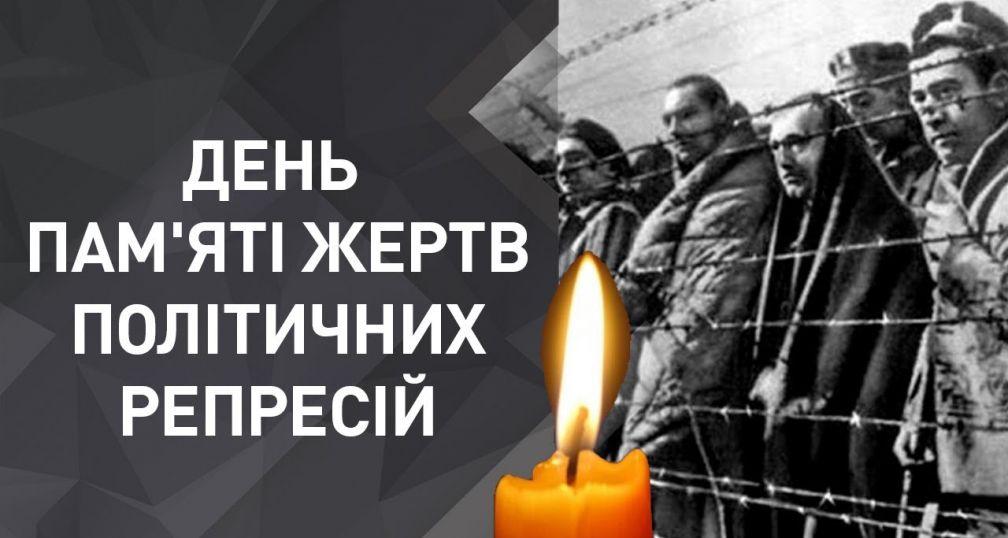
Every year on the third Sunday of May - the Day of Remembrance of Victims of Political Repressions. It is celebrated according to the Presidential Decree of May 21, 2007 to honor the tens of thousands of people shot by the communist regime, hundreds of thousands thrown into prisons and camps, exiled or forced into psychiatric treatment. The number of these martyrs in Ukraine is still impossible to count.
The Bolsheviks immediately after the October Revolution of 1917 embarked on a course of political terror. Since the fall of 1918, it has acquired the status of an official policy of the Soviet government. In Ukraine, the “Red Terror” was launched from the first days of the invasion of Bolshevik troops in early 1918.
The Great Terror was a large-scale campaign of repression of citizens launched in the USSR in 1937–1938 at the initiative of the USSR leadership and personally by Joseph Stalin to eliminate real and potential political opponents, intimidate the population, and change the national and social structure of society.
The consequences of the communist terror of the 1930s in Ukraine were the destruction of the political, artistic, and scientific elite, the deformation of social ties, the destruction of traditional value orientations, the spread of social depression, and denationalization.
All layers of Ukrainian society went through terror and repression: from scientists and artists to workers and peasants.
The Soviet authorities tried to hide the traces of the crimes - they made burial sites "regime objects" of the KGB, leveled them with bulldozers, and prohibited access to the relevant archives.
One of the symbols of those events was the Bykivnyanskyi forest near Kyiv . This is the largest mass grave of victims of communist political repressions in Ukraine. According to various sources, from 20 to over 100 thousand people tortured during interrogations or extrajudicially shot by the NKVD in Kyiv found their final resting place here. The ashes of Mykhailo Semenko, Maik Johansen, Mykhailo Boychuk, Fedor Kozubovsky, Metropolitan of the UAOC Vasyl Lypkivskyi and other victims of Stalin's Great Terror lie here.
Torture, executions of innocent people without trial or investigation, deportations, filtration camps, mass persecutions for political reasons – it seemed that all this would forever remain in history with the fall of the Soviet system. However, after Russia’s invasion of Ukraine, the ideological heirs of the totalitarian regimes in Russia once again brought these horrors to Ukrainian soil.
The Great Terror
During the large-scale repressive campaign of 1937–1938, known as the Great Terror, 198,918 people were sentenced in the Ukrainian SSR, of whom about two-thirds were shot. The rest were sent to prisons and labor camps (only 0.3% were released).
The mass repressive operations of 1937–1938, according to Stalin's plan, were to complete the twenty-year struggle against "socially hostile elements", to subdue the population through terror, to establish an authoritarian style of leadership and to carry out a "cadre revolution". The basis for the deployment of terror was Stalin's idea that as socialist construction progresses, the class struggle intensifies.
The official beginning of the Great Terror was the operational order of the NKVD of the USSR “On the repression of former kulaks, criminal criminals and other anti-Soviet elements” dated July 30, 1937 No. 00447, approved by the Politburo of the Central Committee of the All-Union Communist Party (Bolsheviks) on July 31, 1937. However, available NKVD documents (orders, correspondence, telegrams) indicate that the order only formalized mass repressions, and they were prepared in advance.
This document introduced limits (plans) for punishing citizens. Sentences for the first category meant "shooting", for the second - imprisonment in the Gulag camps of the NKVD of the USSR (from the Russian Main Administration of Camps). If the initial limit for the Ukrainian SSR for the first category was 26,150 people, then in January 1938 it was increased to over 83 thousand. Moreover, the People's Commissars of Internal Affairs of the Ukrainian SSR Izrail Leplevsky and Alexander Uspensky repeatedly appealed to Moscow with a request to provide additional limits.
Even before Order No. 00447 came into force, the authorities had carried out a “cleansing” of the party ranks and security agencies, which was to ensure the unconditional implementation of directives from the center in the future. And already in June 1937, mass arrests began. On July 10, the Politburo of the Central Committee of the CPSU (b) sent an instruction to the regions of the Ukrainian SSR on the formation of an extrajudicial repressive body – regional “troikas” to simplify the sentencing procedure (they completely contradicted Soviet legislation, including the 1936 Constitution). The troikas usually included the head of the regional UNKVD (chairman), the regional prosecutor and the first secretary of the regional, regional or republican party committee.
The vast majority of cases were based on the defendants' own testimonies, who were effectively deprived of the right to defense (to a lawyer) or to appeal the verdict. Using psychological pressure, and even bullying and inhuman torture, investigators "knocked out" the necessary confessions from the arrested, which no one checked. In 1937, permission to use methods of "physical influence on suspects" (i.e. torture) was granted at the highest level of the Central Committee of the All-Union Communist Party (Bolsheviks).
The times of the Great Terror gave rise to total fear and distrust in the mass consciousness of Soviet people. Night arrests of neighbors, suspicions of colleagues at work, friends, relatives, the search for spies and pests, the fear of denunciations and the obligation to publicly brand the so-called enemies of the people were everyday things. Citizens wrote denunciations against colleagues, fearing that they would be the first to denounce them. This became a typical means of resolving personal conflicts with management, teachers, relatives, etc.
The staged show trials against the party and Soviet leaders of 1937–1938 envisaged not only the elimination or marginalization of the remnants of the old elite, but also the influence on the new nominees and society as a whole. Participation in those show trials was supposed to demonstrate political and ideological loyalty, obedience to the will of the leader, and recognition of the applied methods of state administration. This was the method of the “Stalinist cadre revolution.”
The Great Terror was also curtailed on the instructions of the top party and Soviet leadership. On November 17, 1938, the Central Committee of the All-Union Communist Party (Bolsheviks) and the Council of People's Commissars of the USSR adopted a resolution “On Arrests, Prosecutorial Supervision and Investigation,” which “oriented law enforcement agencies to stop the “great purge” and restore elementary legality. The next step was the physical elimination of the direct organizers and executors of the Great Terror.
Some facts about the Great Terror in Ukraine
1. One of the largest burial sites for victims of Stalinist repressions in Ukraine is Bykivnya. The names of over 19,000 executed citizens have already been identified.
2. There are also other places of mass burials of victims of the Great Terror in Ukraine - Rutchenkove Pole (Donetsk), the area of the Park of Culture and Recreation (Vinnytsia), Pyatikhatki (Kharkiv), the Catholic Cemetery (Uman), the Jewish Cemetery (Cherkasy), the village of Khalyavyn (Chernihiv region), the Second Christian Cemetery (Odesa), the 9th km of the Zaporizhzhia Highway (Dnipro). In Western Ukraine after 1939, places of mass burials also appeared, in particular, the tracts of Demyaniv Laz (Ivano-Frankivsk) and Salina (Lviv region), the prison on Lontskoho (Lviv).
3. The bloodiest night in Kyiv was May 19, 1938, when 563 people were shot in NKVD prisons. This usually happened in prison yards, in NKVD basements, or directly at the burial site. Initially, special areas in cemeteries were set aside for mass burials. At the peak of the repressions, this practice was changed to hide the scale of the crimes. Trenches for the murdered were dug in gardens, parks, and suburban forests, and the corpses were often covered with quicklime.
4. On October 27 - November 4, 1937, in the Sandarmokh tract near the city of Medvezhyegorsk in Karelia, 1,111 people were shot, including 287 Ukrainians and people whose fates were connected with Ukraine, on the 20th anniversary of the October Revolution.
5. In 1934–1938, the NKVD of the Ukrainian SSR was located in the buildings of the former Kyiv Institute of Noble Maidens (later the October Palace, now the International Center for Culture and Arts of the Federation of Trade Unions of Ukraine), in 1938–1941 – on Korolenko Street (now Volodymyrska Street), 33. The Kyiv City Department and the NKVD Directorate in the Kyiv Region were located on Rosa Luxemburg Street (now Lypska Street, 16).
6. In 1955, the KGB of the USSR Republic sent Directive No. 108 SS to the regional state security departments, instructing them to notify the relatives of those executed that their relatives had died in places of imprisonment, and if necessary to resolve property or other legal issues, to register the deaths of those executed in registry offices with the issuance of certificates, in which the dates of death should be indicated within 10 years of the date of arrest, and the causes of death should be invented.
7. Within the framework of the Great Terror, the NKVD organized and carried out a series of massive national operations. These were the so-called “German operation” (July 25, 1937), “Polish” (August 11, 1937), “Romanian”, “Latvian”, “Greek”, “Iranian”, “Harbin”, “Afghan”, “against Bulgarians and Macedonians”.
8. The memoirs of the NKVD officers and the results of the exhumation of the bodies indicate a characteristic "handwriting" of the killers. As a rule, these were shots from revolvers of the "Nagan" system to the back of the head or the first cervical vertebra. The Nagan was considered accurate, reliable and powerful enough to cause a fatal wound, and the strong recoil did not save the executioners' strength for mass executions.
9. In the summer of 1937, new regulations were introduced that increased the responsibility of family members of the repressed. Wives and husbands of "enemies of the people" were subject to mandatory arrest, children under 15 were transferred to special orphanages. Family members of "enemies of the people" sentenced to execution were subject to forced resettlement to the interior regions of the USSR.
10. The term “enemy of the people” (Latin hostis publicus) is of ancient Roman origin. It was applied to enemies of the republic, who were equated with soldiers of the opposing side and who were therefore subject to physical destruction. The term became commonly used in 1793–1794 – the time of the Great Terror of the Jacobins in France. In the USSR, this term was not only a widespread cliché of political rhetoric, but also written into the Constitution of 1936 – according to its 131st article, enemies of the people were declared to be persons who committed an attack on public, socialist property.
Based on materials from the Ukrainian Institute of National Remembrance